

Custom Development
Alcohol Delivery Market Share and Trends: Size, Growth, & Business Opportunities
7 Apr 2026
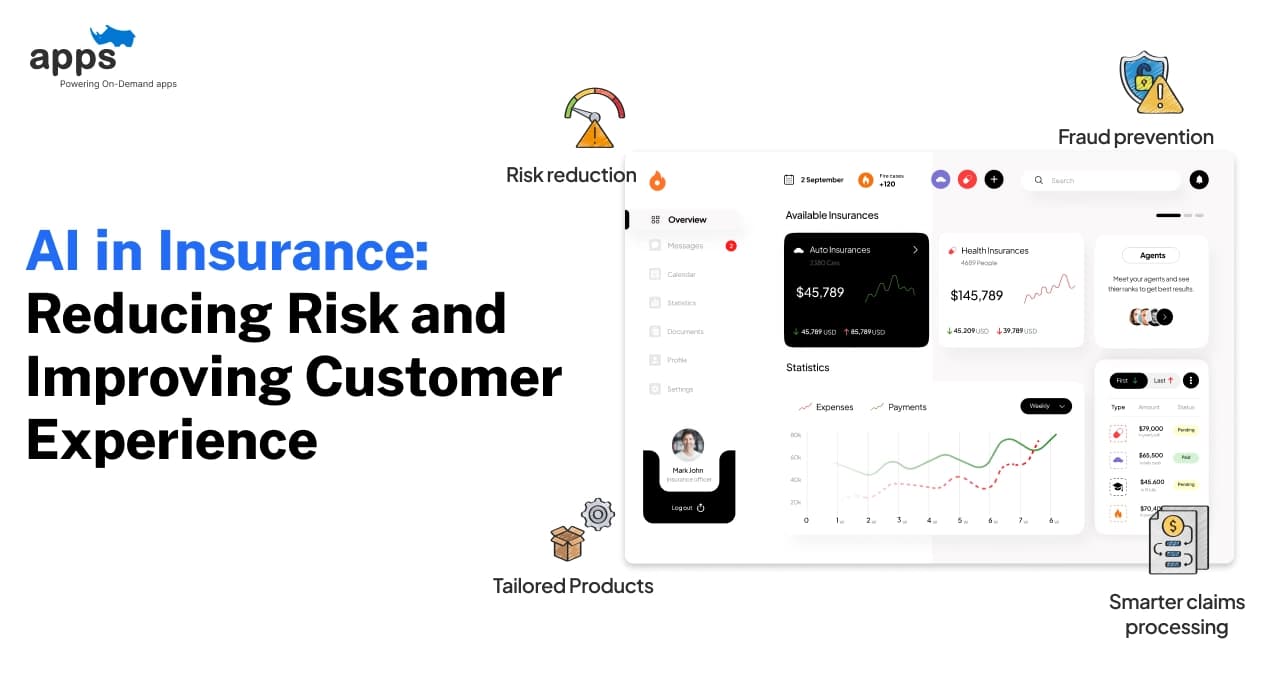
Most people think insurance is slow because the industry “likes paperwork.”
The truth is far more straightforward: traditional systems were never built for real-time decision-making, instant support, or automated risk detection. And that’s precisely why AI in insurance is rewriting the rules faster than any industry expected.
Today, claims that once took days now take minutes.
Risk models that once required teams now require only data. And customers who dreaded long calls now get instant answers. Thanks to claims automation, predictive intelligence, and generative AI in insurance.
From AI risk assessment to fraud detection, from AI auto insurance damage scans to smarter underwriting, the modern AI in insurance industry is shifting from reactive to proactive.
If insurers want speed, accuracy, and happier customers, AI is no longer optional; basically, it’s the upgrade the entire sector has been waiting for.
AI in insurance refers to the use of intelligent technologies such as machine learning, automation, and natural language processing to help insurers work more quickly, make better decisions, and deliver better customer experiences.
Instead of depending on manual reviews or slow paperwork, insurers now use AI in insurance to automate claims, analyze risks, detect fraud, and personalize policies in real time.
Modern advancements like generative AI in insurance and agentic AI in insurance allow systems to summarize documents, guide users, and even take autonomous actions within workflows. This shift makes insurance more accurate, scalable, and customer-friendly.
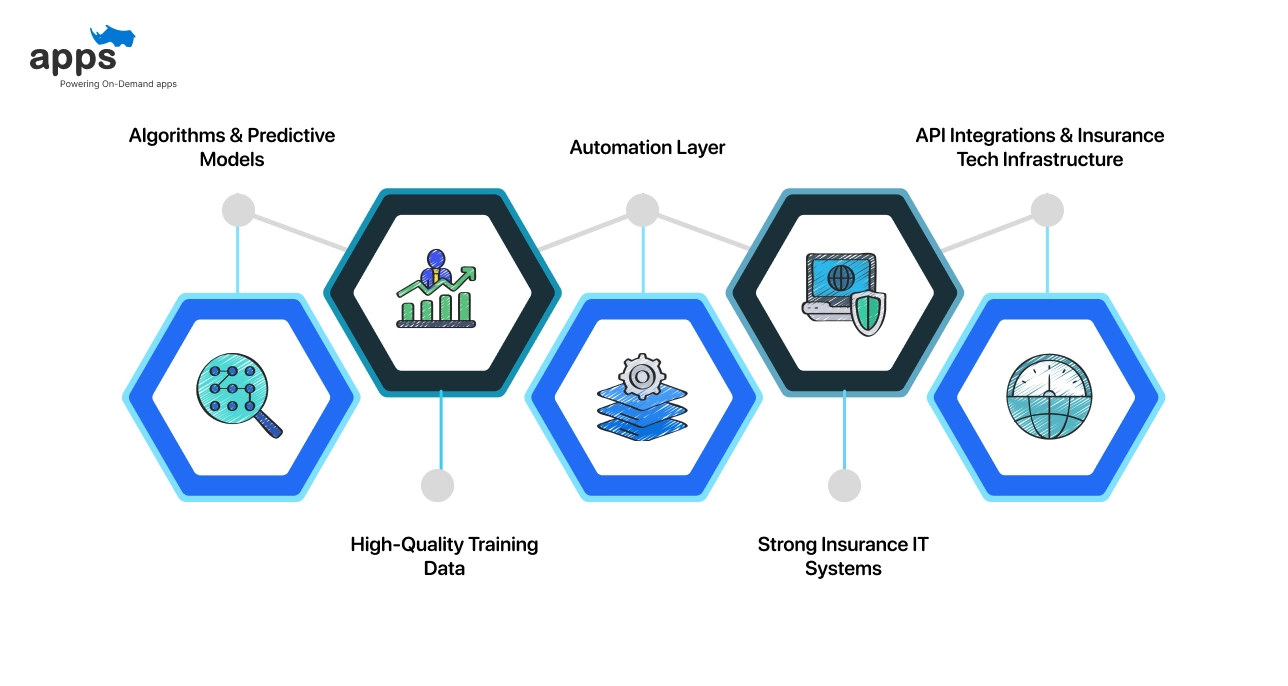
AI transformation in insurance relies on several core components working together to improve accuracy, automation, and decision-making:
Algorithms & Predictive Models: Learn from historical data to identify patterns, improve underwriting, and support smarter AI risk assessment across fraud, claims, and pricing.
High-Quality Training Data: Ensures AI systems understand real-world scenarios such as medical cases, accident details, and fraud behaviors, which is critical for accurate AI claims processing.
Automation Layer: Handle repetitive insurance tasks like document checks, verification, and claims automation, reducing manual effort and errors.
Strong Insurance IT Systems: Connect policy, claims, CRM, and analytics systems to enable smooth automation and real-time workflows.
API Integrations & Insurance Tech Infrastructure: Modern APIs connect internal tools and third-party solutions, enabling seamless insurance technology for underwriting, fraud detection, and claims handling.
Together, these components form the foundation that powers modern insurance companies using AI and supports scalable digital transformation.
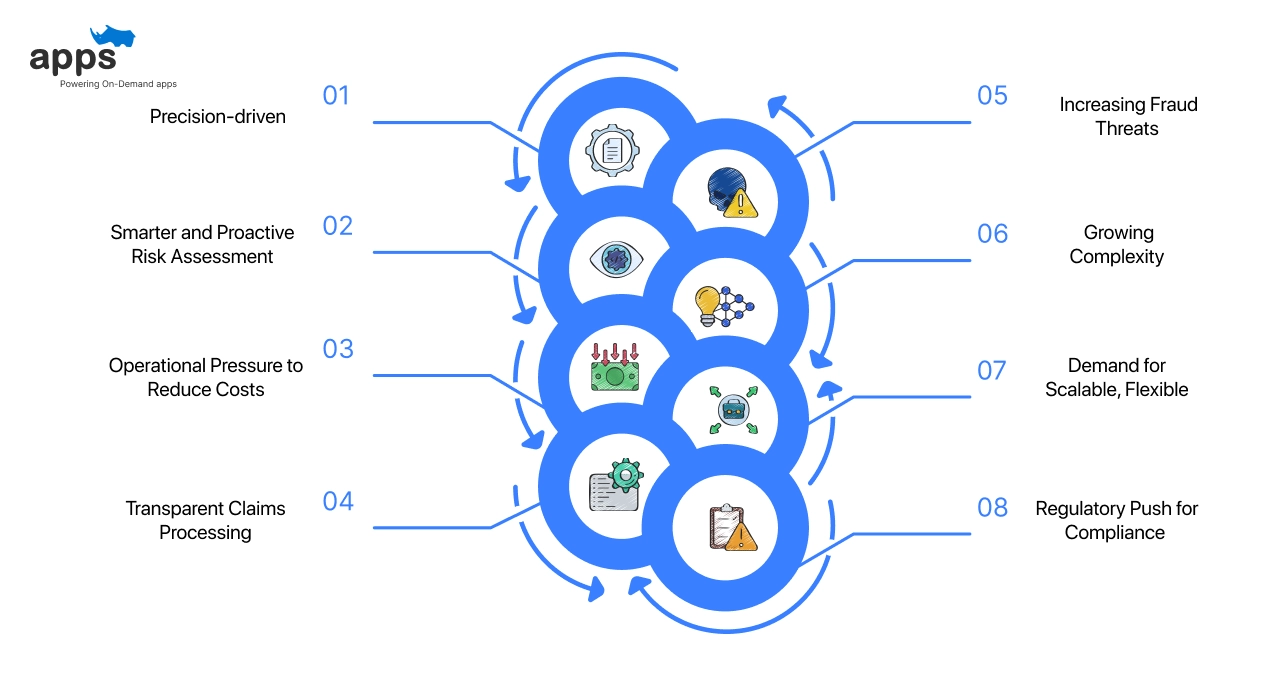
Insurance is facing one of its most significant shifts in decades. Customers want instant answers, risks are becoming more complex, and traditional systems can’t keep up with today’s speed.
This is why AI in insurance is no longer a future concept; instead, it’s a competitive requirement. Below are the key reasons why AI matters right now.
Policyholders expect quick claims, instant support, and personalized experiences. AI enables real-time responses, automated verification, and accurate decision-making. Tools powered by generative AI in insurance streamline document handling and interactions, reducing delays and frustration.
Traditional risk analysis is slow and reactive. AI uses predictive analytics to identify potential losses before they happen. This strengthens AI risk assessment, improves underwriting accuracy, and helps insurers price policies with better insight.
Manual reviews, paperwork, and back-office tasks drain both time and money. AI-driven claims automation and workflow optimization dramatically reduce operational load. With AI handling routine tasks, teams can focus on more strategic responsibilities.
In the modern AI claims ecosystem, speed builds trust. AI helps insurers detect fraud, extract data from documents, and streamline approvals. This improves the entire insurance claims processing workflow, cutting cycle time from days to minutes.
For a more detailed walkthrough of this critical process, you can find a comprehensive guide to claims process automation here, showing how cycle time is cut from days to minutes.
Fraud is growing more sophisticated. AI identifies unusual behavior, cross-checks patterns, and flags inconsistencies that humans might miss. This protects both insurers and customers while reducing unnecessary claim payouts.
From AI auto insurance damage detection to AI in health insurance medical validation, AI simplifies complex processes. These improvements lead to better accuracy and improved customer satisfaction across diverse insurance products.
Legacy insurance IT systems limit growth. AI offers automation, real-time insights, and cross-platform integrations that support scalable, future-ready operations. This is why nearly all leading industry players are shaping the insurance world with Joget and other next-gen platforms to outperform their competitors.
This is why nearly all leading insurance companies using AI are outperforming their competitors.
AI helps insurers meet compliance requirements by maintaining audit trails, ensuring consistent decisions, and strengthening data governance. It improves accuracy while reducing the risk of compliance violations.
Next, let’s explore the advanced technologies powering this transformation and how insurers use them every day.
From fraud detection to claims automation, these advanced technologies don’t just make the job easier; they make insurance smarter, more accurate, and far more customer-friendly.
Let’s look at the key types powering modern insurance.
Machine learning (ML) helps insurers understand patterns humans often miss. It analyzes years of customer, claims, and market data to more accurately predict risks. This means fewer manual checks, faster pricing decisions, and more consistent underwriting. ML also strengthens AI risk assessment by spotting early signals of fraud or potential loss.
Tools like ChatGPT-style engines enable generative AI in insurance to summarize documents, clean up messy claim descriptions, draft email responses, and even explain policies in simple language.
If you want to explore benefits of Generative AI features within an app, you'll find that it cuts down hours of repetitive work and makes the entire insurance claims processing workflow more efficient. It cuts down hours of repetitive work and makes the entire insurance claims processing workflow more efficient.
Agentic AI is where things get exciting. It doesn’t just give answers it takes action. Think of it as AI on autopilot. It can route claims, approve low-risk cases, detect anomalies, and assign tasks without waiting for human intervention. This makes claims automation far more effective and reduces delays caused by manual workflows.
NLP helps insurers understand human language from customer emails to accident descriptions. It extracts essential data, flags missing information, and improves customer interactions through chatbots that respond instantly. This enhances service speed across AI claims, policy questions, and onboarding.
Computer vision enables AI to “see” images of damaged vehicles and property. It compares photos with historical data to quickly estimate repair costs. This is becoming a game-changer in AI auto insurance, where customers often want lightning-fast claim decisions.
Predictive analytics uses data to forecast risk, detect fraud, and refine pricing models. It strengthens overall insurance strategy and allows insurers to prepare for patterns before they appear, something traditional models simply can’t do.
IoT devices collect live data from cars, homes, and wearable health trackers. AI analyzes this information to detect anomalies, send alerts, or offer personalized coverage. It improves AI in health insurance, auto risk monitoring, and even home safety.
Up next, let’s explore real-world AI in insurance use cases and how they’re shaping the industry.
From faster claims to smarter underwriting, AI is quietly eliminating the slow, repetitive tasks that used to drain teams. What once took days now takes minutes. And what once relied on guesswork now runs on data.
These real, proven AI in insurance use cases show how insurers are transforming operations, reducing risk, and improving customer experience without adding more paperwork to anyone’s life.
AI automates the entire insurance claims processing workflow from document extraction to fraud checks to approval routing.
For an in-depth understanding of how carriers achieve this efficiency, see what is automated claims processing for insurance. Claims that earlier needed several back-and-forth emails now move through automated verification.
This dramatically reduces processing time and improves customer satisfaction, especially in high-volume technology insurance claims environments.
Machine learning models analyze risk, customer history, lifestyle data, and pricing patterns to support accurate underwriting.
Instead of lengthy approvals, AI helps insurers make consistent decisions quickly, improving efficiency across insurance IT systems while reducing underwriting delays.
AI flags unusual activities by analyzing thousands of variables simultaneously, something humans simply can’t do at scale. It identifies hidden patterns, mismatched details, and suspicious claim behavior.
This helps insurers prevent losses and strengthen AI risk assessment across different policy types.
AI studies customer behavior, income, life stage, and claim history to recommend the right policy at the right moment. This helps insurers personalize experiences, boost upsell opportunities, and improve retention.
It also enhances insurance strategy with data-backed insights.
In AI in health insurance, AI verifies medical documents, cross-checks conditions, and speeds up approvals for treatments or reimbursements. It reduces errors, avoids delays, and helps customers receive healthcare support faster without endless paperwork.
AI uses computer vision to assess vehicle damage from images and estimate repair costs instantly. Telematics data (braking, speed, driving behavior) helps insurers calculate risk more accurately. These capabilities make AI auto insurance smarter and more transparent for customers.
AI chatbots answer policy questions, track claim status, assist with renewals, and solve routine queries 24/7. This reduces human workload and maintains consistent customer support. In many insurance companies using AI, chatbots now handle over 50% of customer interactions.
AI automates repetitive tasks like data entry, document indexing, and cross-verification. This reduces operational fatigue and frees teams to focus on higher-value tasks. Insurance automation also improves accuracy and keeps systems functioning smoothly.
AI predicts renewal likelihood, monitors deadlines, and sends personalized reminders. It ensures policyholders never miss renewal dates and improves customer retention. AI also supports dynamic pricing and policy customization based on behavioral patterns.
Next, let’s explore the clear benefits of using AI in insurance and how these use cases deliver measurable results.
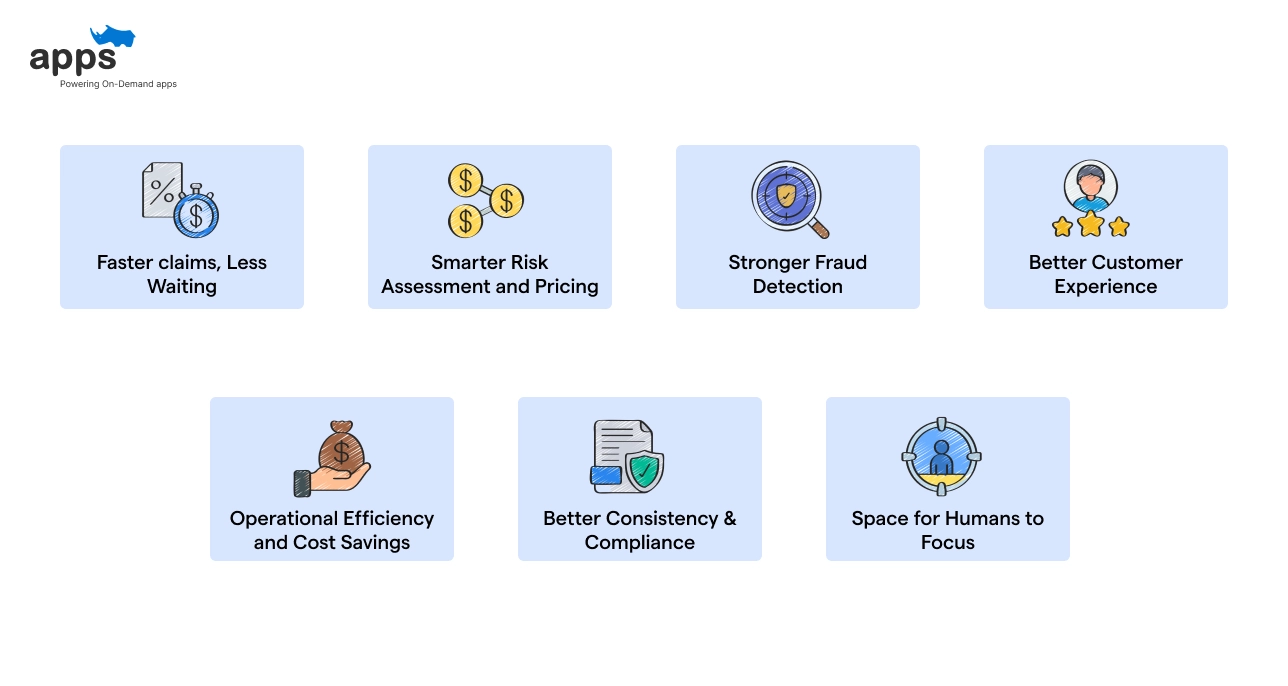
AI in insurance has become mainstream. It quietly reduces claim times, improves risk models, and saves insurers serious money when used effectively.
Studies by McKinsey show that insurers adopting generative AI in insurance and automation are seeing double digit productivity gains and happier customers, not just cool dashboards.
Here are the biggest, proven benefits you can expect.
This is where claims automation shines. AI can read documents, validate data, route cases, and even approve low-risk AI claims with minimal human touch. A Nordic insurer working with EY now processes claim documents in near real time, with about 70% of documents automatically extracted and interpreted by AI.
A 90% reduction in claims processing time has been reported using an AI claims bot that handles the entire flow from verification to payout. For customers, that means less “we’ll get back to you” and more “money already in your account.”
Risk is where AI risk assessment really proves its worth. Advanced models ingest years of loss history, external data, weather, demographics, and behavior to support more accurate pricing across the AI in insurance industry.
Capgemini’s 2024 World Property and Casualty Insurance Report highlights a small group of “underwriting trailblazers” (about 8% of P&C insurers) that use AI-driven insights and automation, consistently outperforming peers in risk selection and underwriting quality.
For insurers, this means better combined ratios. For customers, it means prices that reflect real risk rather than broad guesswork.
Fraudsters are creative. AI is more patient.
Modern insurance technology solutions use machine learning to flag unusual patterns across policies, behavior, devices, and transactions. These models score risk in real time, helping investigators focus on high-risk cases instead of manually scanning every claim.
McKinsey notes that advanced AI in insurance deployments can improve technical results (loss and expense ratios) by 1.5 to 3 percentage points, in part by catching fraud and leakage earlier. Even a one-point improvement can translate into millions saved for large carriers.
Customers do not care how clever your claims processing systems are; now they care how fast and clearly you respond. Accenture estimates that poor claims experiences could put up to $170 billion in premiums at risk by 2027, which makes CX a costly problem to ignore.
Here, generative AI in insurance is already making a difference. Allstate uses GPT-based models to draft customer communications; internal tests showed AI-generated emails were more empathetic and easier to understand than many human-written ones.
The Wall Street Journal and Deloitte also report that generative AI in contact centers can cut call handling time by about 3 minutes per interaction while improving the experience.
Add in personalized offers, usage-based AI auto insurance, and proactive nudges in life insurance tech, and AI starts to feel less like a robot and more like a helpful guide.
Done well, insurance automation is basically “do more with the same team, without burning them out.”
A McKinsey survey of major European insurers found that leaders expect 10–20% productivity gains and 1.5–3% premium growth from scaled gen AI deployments.
A 2024 technical study referencing Accenture’s claims and underwriting research reports up to 80% reduction in claims processing time and 50% lower underwriting costs in fully integrated AI architectures, along with a 70% drop in manual interventions.
No one is promising magic, but for insurers willing to redesign workflows around AI, the efficiency upside is very real.
Regulators expect decisions to be explainable. Customers expect them to be fair.
When embedded in insurance IT systems, AI models can apply rules consistently across underwriting, health insurance, and insurance claims. Standardized decision flows, logs, and model monitoring make it easier to prove how a decision was made and to demonstrate adherence to internal policies and regulations.
This structured approach supports governance around emerging tech like agentic AI in insurance, and reduces the risk of “random exception” decisions that later become expensive compliance headaches.
The most significant hidden benefit of AI in insurance use cases is not that machines are clever. It is that humans finally get to do the work they are actually good at.
When AI handles repetitive tasks such as checks, document review, and status updates, teams can focus on complex claims, nuanced insurance strategies, and empathetic conversations with customers.
EY’s Nordic case study shows that with 70% of documents processed automatically, agents spent more time advising customers and less time staring at PDFs.
Happier teams plus faster processes usually equal lower churn on both sides.
AI is clearly delivering measurable, real-world benefits in insurance, but it is not without challenges around data, trust, and regulation. That is precisely what we will unpack next.
AI may be transforming the AI in insurance industry, but let’s be honest, it’s not all magic, algorithms, and instant claims approvals. Adopting it comes with real hurdles.
Here are the biggest challenges insurers face while adopting AI in insurance today and why solving them is worth it.
AI thrives on clean, structured, high-quality data.
Insurance data? Often messy, siloed, incomplete, or stored in systems older than some employees.
Poor data slows down underwriting models, reduces risk prediction accuracy, and limits the effectiveness of claims automation.
Common challenges:
Many insurers still rely on 20-year-old insurance IT systems. Connecting AI to these systems feels like plugging a Tesla charger into a vintage car.
These outdated systems slow down AI adoption and restrict scalability across underwriting, AI claims, and automation workflows.
Insurance operates under strict regulations, including HIPAA, GDPR, NAIC rules, and others.
AI must follow every rule, every time.
Challenges include:
Insurers want speed, but regulators want clarity. AI must offer both.
If training data includes bias, AI may unintentionally discriminate in AI risk assessment, premium pricing, or claims approval.
Insurers must constantly test AI outputs to ensure fairness for all demographic groups. This is a significant regulatory priority in 2025.
AI reduces costs in the long term… but getting started isn’t cheap.
Expenses include:
The good news? ROI usually appears within months once insurance automation takes over.
Customers expect clear explanations.
AI models? Not always great at storytelling.
Insurers must implement Explainable AI (XAI) to satisfy customers, auditors, and compliance teams, especially for AI auto insurance and AI in health insurance decisions.
AI specialists, data scientists, and ML engineers are in high demand and short supply.
Most insurers need external support to build or manage advanced insurance technology solutions.
This slows adoption and creates dependency on outdated processes. If you are looking to address this gap internally, check out how to develop an AI app for a roadmap.
AI cannot work in isolation. It must integrate smoothly with:
Many insurers struggle with fragmented systems, making AI integration a long, complicated process.
Employees worry that automation will lead to job replacement.
In reality, AI handles repetitive tasks, while humans handle strategy, relationships, and judgment-heavy cases.
But change management remains a significant hurdle to AI adoption.
AI offers significant advantages, but insurers must balance innovation with practicality. With the right team and strategy, these challenges become stepping stones rather than roadblocks.
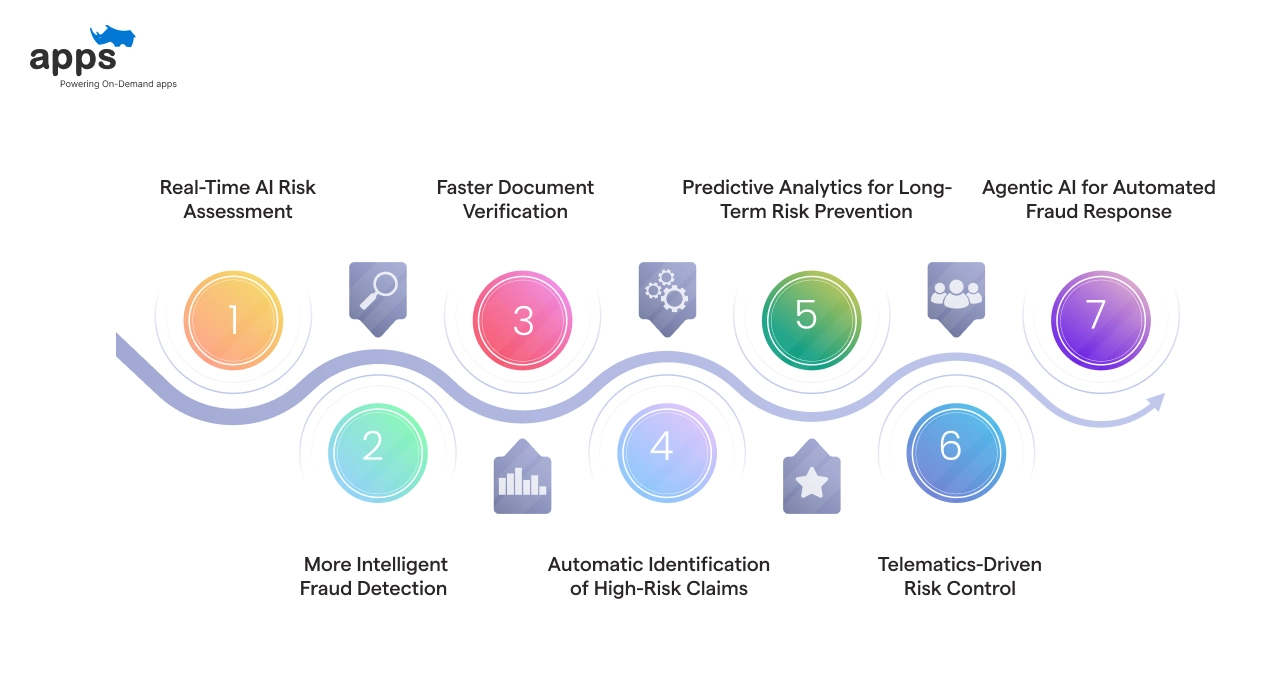
Fraud is smarter, claims are more complex, and manual review just can’t keep up.
That’s why AI in insurance has become essential. It acts as your always-awake, never-tired digital investigator, helping insurers predict risk, detect fraud, and make decisions faster.
AI analyzes customer history, behavioral trends, and external data sources within seconds. This allows insurers to score risks more accurately and support underwriting with clean, predictable insights.
The result is fewer uncertainties, improved pricing models, and stronger AI risk assessment across every policy.
Fraud has patterns, and AI is brilliant at spotting them. Using machine learning, insurers can detect repeated behaviors, manipulated documents, or abnormal claim patterns instantly.
This keeps fraudulent payouts low and strengthens the integrity of the overall insurance claims processing workflow.
Claims often involve piles of medical reports, repair bills, invoices, and handwritten notes. AI reads and verifies these documents through NLP, identifies mismatches, and flags suspicious entries.
This makes technology insurance claims faster, more accurate, and much less painful for human teams.
AI models evaluate incoming claims and classify them by risk level. Low-risk cases are processed quickly, while suspicious ones undergo more thorough checks. This reduces delays for genuine customers and supports fairer, more transparent claims automation.
AI studies large-scale historical data to anticipate future risks. It helps insurers understand which regions may see higher fraud trends, which policies may become loss-heavy, and how customer behavior will shift.
These insights strengthen your overall insurance strategy and reduce long-term financial exposure.
In AI auto insurance, telematics devices and IoT sensors record driving behaviors such as speeding, braking, and mileage. AI analyzes this data to predict accident probability and reward safer drivers. This encourages better road behavior and drastically reduces claim volumes.
Unlike traditional systems, agentic AI in insurance doesn’t just detect problems; it reacts to them. It can freeze a suspicious claim, alert investigators, cross-check documents, or trigger deeper verification without waiting for human input. This makes fraud prevention proactive and instantaneous.
AI is now a core pillar for reducing risk, detecting fraud, and making insurance operations smoother and more trustworthy, all while improving the customer experience.
AI isn’t just a “nice upgrade” for insurers anymore; in fact, it’s the new operating system. But getting AI right requires more than plugging in a model. Insurers need the right tools, the right integrations, and the right team to make everything work in real life, not just in a pitch deck.
That’s why so many insurers rely on AppsRhino. We bring practical engineering, automation depth, and insurance-specific AI frameworks that help carriers scale smarter and faster.
AppsRhino offers pre-trained AI engines tailored for underwriting, claims automation, fraud detection, and policy servicing. Insurers get faster outcomes without spending months training models from scratch.
We connect AI seamlessly with underwriting tools, policy systems, CRMs, and claims processing systems. No chaos, no rewiring your entire stack, is just smooth, plug-and-play automation.
Our agentic AI in insurance automatically executes tasks such as document verification, claim triage, and customer responses. It’s like hiring a digital employee who never gets tired (or asks for vacation).
From drafting policy summaries to creating personalized health recommendations, generative AI in insurance helps insurers reduce manual effort and deliver instant service with accuracy.
We follow strict compliance for life insurance tech, health insurance, and auto insurance data standards. End-to-end encryption and governed access keep your customer information completely protected.
AppsRhino’s AI reads documents, verifies details, and flags inconsistencies in seconds. This helps insurers reduce claim cycle times by up to 60% and deliver smoother AI claims experiences.
Whether you operate on AWS, Azure, GCP, or hybrid systems, AppsRhino adapts to your architecture. You gain AI automation without restructuring your existing insurance IT systems.
AppsRhino doesn’t stop after deployment; we support scaling, optimization, and long-term automation across your entire insurance strategy. Your team always has experts behind the scenes keeping everything running smoothly.
Our models analyze behavior, historical loss patterns, and real-time signals to improve AI risk assessment. That means better pricing decisions and fewer surprises down the road.
Whether you’re an AI insurance company, a health insurer, an auto carrier, or specialty line provider, we build AI that fits your needs, not generic templates.
AppsRhino helps insurers adopt AI quickly, with confidence, and with real business impact, without the complexity or risk of doing it alone.
Insurance has always been about managing the unexpected, and let’s be honest, nothing gets more “unexpected” than modern customer demands.
Thankfully, AI in insurance is rewriting the rules. From instant claims automation to smarter AI risk assessment, insurers can finally stop juggling spreadsheets at midnight and start delivering real, enjoyable customer experiences.
And this is precisely where AppsRhino shines. We don’t just plug in AI; we build practical, scalable, real-world solutions that fit right into your workflows.
Whether you're exploring generative AI in insurance, agentic automation, or advanced insurance technology solutions, we help you adopt AI that works, not AI that breaks things on a Monday morning.
Ready to modernize your insurance operations without losing your sanity?
We’re here for it.
Custom Development
7 Apr 2026
Tell us what your business actually runs on today, and we will map what it takes to make it one system.