- TL;DR: How to Build a Grocery Delivery App Like Instacart
- What is an Instacart-like grocery delivery app
- How Does Instacart Work?
- Types of Grocery Apps You Can Build
- Key Features of a Grocery Delivery App Like Instacart
- Step-by-Step Process to Build an App Like Instacart
- Tech Stack for Instacart Grocery Delivery Mobile App Development
- Cost to Build a Grocery Delivery App Like Instacart
- Monetization Models for Apps Like Instacart
- Challenges in Building an App Like Instacart and How to Solve Them
- Build vs Buy Instacart Clone App
- Looking for the Right Partner to Build Your Instacart-Like App?
- Final Thoughts
- Frequently Asked Questions (FAQs)
Table of Contents
How to Build On-Demand Grocery App Like Instacart

Grocery shopping has shifted from physical aisles to on-demand apps, creating a high-frequency, repeat-use business opportunity. What started as convenience has quietly become a billion-dollar shift toward digital-first shopping.
For businesses, that shift is a real opportunity. Building a grocery delivery app like Instacart means tapping into recurring, high-frequency demand that shows no signs of slowing down.
But most guides miss the real challenge. It's not about launching an app; it's about getting the business model, features, and early decisions right. Those are what separate apps that scale from apps that stall.
In this guide, you'll learn exactly how to build an app like Instacart, how it works, key features, tech stack, cost, and the right model to launch and grow successfully.
TL;DR: How to Build a Grocery Delivery App Like Instacart
- Instacart-like apps connect customers, stores, and delivery partners in one real-time system. It's a multi-role platform, not just a single app
- The right business model, such as single store, marketplace, hyperlocal, or SaaS-based, matters more than features and should be decided first
- Core build includes four parts: customer app, shopper app, store panel, and admin dashboard
- MVP costs start at $15,000, mid-level at $30K–$80K, and full-scale platforms at $80K–$150K+
- Flutter, React Native, Node.js, and Google Maps API are the go-to stack for most builds in 2026
- Revenue comes from commissions, delivery fees, subscriptions, and in-app advertising
- Custom builds outperform clone solutions on scalability, branding, and long-term control
- The biggest variable isn't budget or features, it's who builds it and how well they understand grocery ops
What is an Instacart-like grocery delivery app
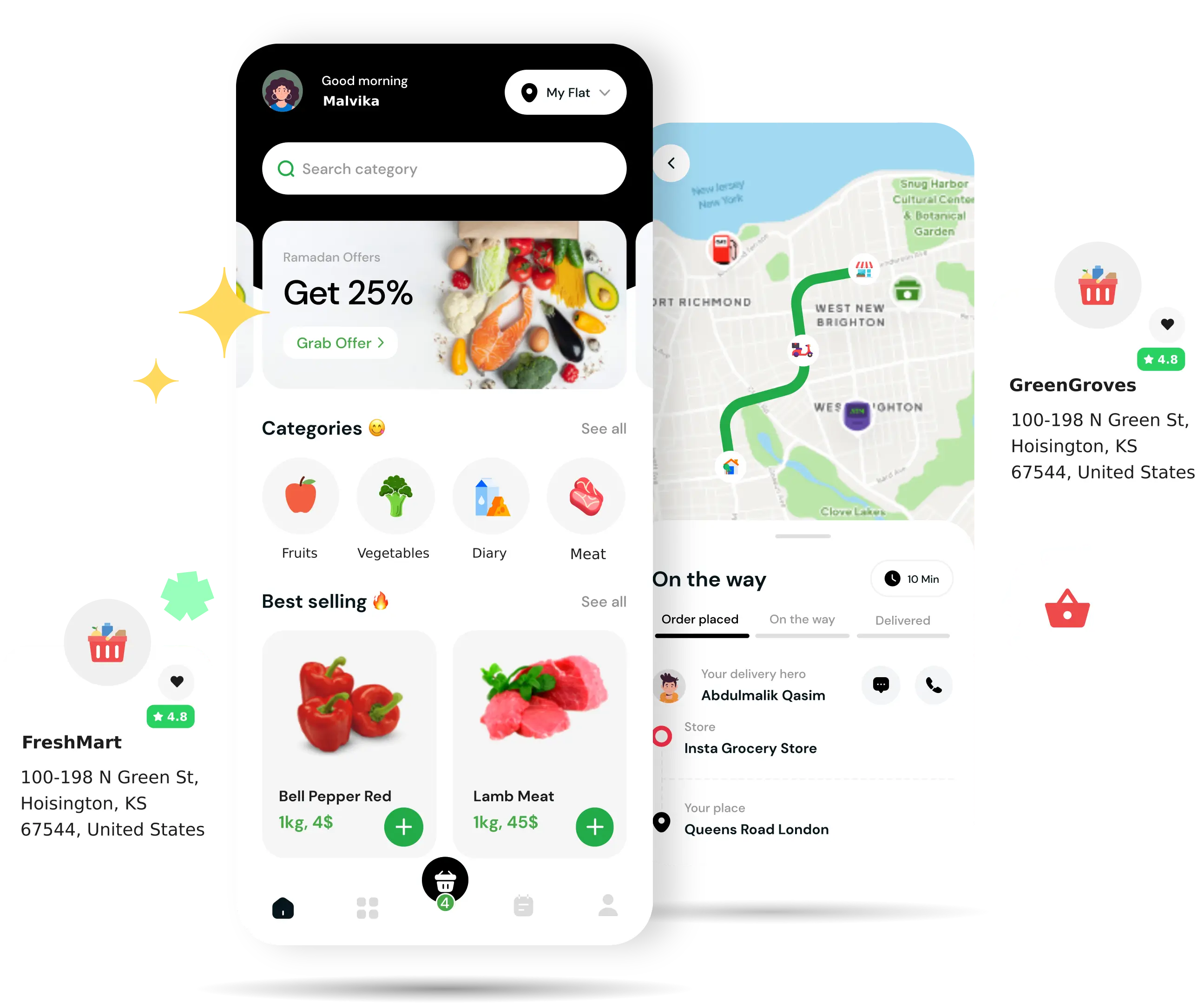
An Instacart-like grocery delivery app is a platform that connects customers, grocery stores, and delivery partners in one system. Users can browse products, place orders, choose delivery or pickup, and track everything in real time.
When you build a grocery delivery app like Instacart, you are creating a multi-role ecosystem, not just a single app. It powers most modern grocery apps, including Instacart, and supports both delivery and pickup models.
It typically includes:
- Customer app for browsing, ordering, and tracking
- Shopper or delivery app for picking and delivering orders
- Store or vendor panel for inventory and order management
- Admin dashboard for overall control, analytics, and operations
Flow:
Customer places order → Store confirms → Shopper picks items → Delivered or picked up
This structure is the foundation of on-demand grocery app development and any scalable grocery delivery mobile app development solution.
How Does Instacart Work?
Instacart works as a real-time coordination system between customers, stores, and delivery partners. It simplifies ordering, fulfillment, and delivery into a smooth, trackable flow.
Let’s have a look at how each part of the system works.
User Journey
- Start browsing: Open the app, enter your location, and view nearby stores
- Explore products: Search or browse categories to find required items
- Add to cart: Select products and review the cart before checkout
- Choose slot: Pick a delivery or pickup time based on availability
- Place order: Complete payment and confirm the order
- Track order: Monitor real-time updates until delivery or pickup
Shopper and Delivery Flow
- Receive order: Shopper gets notified about a new order request
- Visit store: Go to the assigned store location to begin shopping
- Pick items: Collect items as per the customer’s list
- Manage substitutions: Suggest or confirm alternatives if items are unavailable
- Pack order: Prepare and finalize the order for dispatch
- Complete delivery: Deliver to the customer or mark ready for pickup
Admin and Store Flow
- Manage listings: Update product catalog, pricing, and availability
- Process orders: Accept and organize incoming customer orders
- Assign tasks: Coordinate with shoppers for order fulfillment
- Track operations: Monitor order status and delivery progress
- Handle support: Manage refunds, issues, and performance analytics
Simple flow:
Browse → Add to cart → Place order → Items picked → Delivered or picked up
This structured workflow is the backbone of grocery delivery app development, ensuring a smooth, scalable experience for all users.
But understanding how the system works is only the first step. The real impact comes from how well it is designed, built, and executed in a real-world environment.
That is where having the right development partner makes a difference. Teams that have already built and scaled similar systems, such as AppsRhino, can help translate this workflow into a reliable, high-performing product without unnecessary trial-and-error.
Types of Grocery Apps You Can Build
Not every business needs the same model when planning to build a grocery delivery app like Instacart. The right structure depends on your scale, operations, and growth goals.
Let’s have a look at the main types of grocery apps you can build.
| App Type | Description | Use Case |
| Single Store App | A dedicated app for one grocery store to manage orders, delivery, and customers directly. | Best for local stores or chains building their own digital presence |
| Multi Store Marketplace | A platform connecting multiple stores where users can compare, shop, and order from different vendors. | Ideal for startups aiming to build platforms similar to apps like Instacart |
| Hyperlocal Delivery App | Focuses on quick deliveries from nearby stores within a limited geographic area. | Suitable for businesses targeting fast delivery in specific cities or zones |
| Grocery Pickup App | Allows users to order online and pick up from the store at a scheduled time. | Useful for businesses that want to reduce delivery costs and improve store traffic |
| SaaS Based Grocery Solution | A ready-to-use platform that businesses can customize and launch quickly without building from scratch. | Great for companies looking for a scalable SaaS based grocery delivery app solution |
Choosing the right model early simplifies development and, if you're deciding between models, helps you understand the differences between a grocery business like an Instacart clone or a Grofers clone, which can narrow the right direction early.
Key Features of a Grocery Delivery App Like Instacart
To successfully build an app like Instacart, you need features that do more than just function; they need to deliver a fast, reliable, and intuitive experience for every user.
Let’s have a look at what each part of the app must deliver.
Customer App Features
This is where the entire experience begins. If this layer feels smooth, users stay. If not, they leave.
| Feature | Description |
| Easy onboarding | Quick signup using mobile number or social login |
| Smart search | Search products with filters and categories |
| Product browsing | View items with images, pricing, and details |
| Cart management | Add, update, or remove items easily |
| Flexible checkout | Multiple payment options for convenience |
| Delivery or pickup selection | Choose preferred delivery or pickup slots |
| Real-time tracking | Track order status from store to doorstep |
| Order history | Reorder frequently purchased items quickly |
| Push notifications | Get updates on orders, offers, and alerts |
| Ratings and reviews | Share feedback and improve trust |
Once the customer experience is seamless, the focus shifts to how efficiently orders are fulfilled behind the scenes.
Delivery or Shopper App Features
This layer ensures that every order is picked, packed, and delivered without delays or confusion.
| Feature | Description |
| Order alerts | Receive notifications for new delivery requests |
| Pickup details | Access store location and instructions |
| Optimized routing | Navigate efficiently using map integration |
| Item picking flow | Follow structured lists for faster shopping |
| Substitution handling | Suggest alternatives for unavailable items |
| In-app communication | Connect with customers via chat or call |
| Earnings dashboard | Track income and completed deliveries |
| Delivery confirmation | Mark orders as delivered or ready |
But even the best delivery flow needs a strong control system to keep everything running smoothly.
Admin Panel Features
This is the backbone of the entire platform, where operations, performance, and control come together.
| Feature | Description |
| User management | Manage customers, shoppers, and vendors |
| Order control | Monitor and assign orders in real time |
| Inventory sync | Update product listings and availability |
| Payment management | Track transactions and payouts |
| Analytics dashboard | Monitor performance and key metrics |
| Offer management | Create and manage discounts |
| Support system | Handle refunds, complaints, and queries |
And to truly stand out in a competitive market, basic features alone are not enough.
Advanced Features to Stay Competitive
These features help you move from a functional app to a smarter, more scalable platform.
| Feature | Description |
|---|---|
| AI recommendations | Suggest products based on user behavior |
| Demand forecasting | Predict demand to optimize inventory |
With the right feature foundation in place, the next step is to understand how to turn these capabilities into a working product through a clear and structured development process.
Step-by-Step Process to Build an App Like Instacart
Building a scalable grocery platform is about following the right sequence, not just writing code. Each step lays the foundation for how your app performs in real use.
Let’s have a look at the step-by-step process.
1. Start with market research
Understand user behavior, delivery expectations, and local demand before you build a grocery delivery app like Instacart. Analyze competitors to identify gaps and opportunities.
2. Choose your business model
Decide between a single store, a marketplace, a pickup, or a SaaS-based grocery delivery app solution. This choice defines your features, operations, and scalability.
3. Define app scope and user flows
Map how customers, shoppers, stores, and admins will interact across the platform. This clarity is essential when planning how to build an app like Instacart efficiently.
4. Design a simple user experience
Create clean and intuitive screens for browsing, checkout, and tracking. A smooth experience is key, since users instantly compare new products with grocery apps like Instacart.
5. Develop core app modules
Build the customer app, delivery app, and admin panel in a structured way. This is where grocery delivery mobile app development turns into a working product.
6. Integrate essential tools
Add payments, maps, notifications, and analytics to support real-time operations. These integrations are critical for smooth online grocery app development.
7. Test and launch strategically
Test all user journeys, then launch in a focused market and improve based on feedback. This approach helps you make an app like Instacart without unnecessary complexity.
With the process in place, the next step is choosing the right tech stack to support performance and long-term scalability.
Tech Stack for Instacart Grocery Delivery Mobile App Development
Choosing the right tech stack is critical for performance, scalability, and long-term growth. A well planned setup makes grocery delivery app development smoother and helps you avoid costly rebuilds later.
Let’s have a look at the core components.
Frontend (User Interface)
This is what users interact with, so it needs to be fast, responsive, and easy to navigate across devices. A strong frontend improves engagement and retention in any grocery mobile app development setup.
Tech Stack: Flutter, React Native, Swift, Kotlin
Backend (Server Logic)
The backend handles business logic, order processing, user management, and real-time operations. A scalable backend is essential when planning how to develop an app like Instacart.
Tech Stack: Node.js, Python, Java, Ruby on Rails
GenAI and AI Automation Layer
This layer enhances your app with intelligent features like recommendations, chat support, and demand prediction. It helps improve user experience, automate operations, and make your grocery delivery app more efficient and scalable.
Tech Stack: OpenAI, Gemini, Claude, LangChain, Pinecone, Weaviate, TensorFlow, PyTorch
Database (Data Storage)
The database securely stores user data, orders, inventory, and transaction details. It should support fast queries and real-time updates for a smooth grocery delivery app.
Tech Stack: MongoDB, PostgreSQL, MySQL, Redis
APIs and Integrations
APIs connect your app to external services such as payments, maps, and notifications. These integrations are key to building a reliable system, as in any Instacart clone app development project.
Tech Stack: Stripe (payments), Google Maps (location), Firebase (notifications), Twilio (communication)
With the right tech stack in place, the next step is to understand the costs involved in building and scaling your grocery app.
Cost to Build a Grocery Delivery App Like Instacart
The cost to build a grocery delivery app like Instacart depends on the level of features, scale, and complexity you plan to launch with. A clear understanding of cost tiers helps you plan better and avoid overspending early.
Let’s break down the cost based on development stages.
Estimated Development Cost (2026)
| App Level | Description | Estimated Cost |
| MVP (Basic Version) | Core features like browsing, cart, checkout, and basic delivery tracking for early launch | $15,000 – $30,000 |
| Mid-Level App | Includes multi-store support, real-time tracking, payment integrations, and an admin panel | $30,000 – $80,000 |
| Advanced Platform | Full-scale system with AI features, analytics, multi-city support, and high scalability | $80,000 – $150,000+ |
These ranges reflect current 2026 development trends across global markets and are commonly used in grocery delivery mobile app development projects.
Key Factors That Affect Cost
- Feature complexity: Advanced capabilities like real-time tracking, AI recommendations, and analytics increase development effort
- Platforms covered: Building for iOS, Android, and web adds more time and cost compared to a single platform
- Third-party integrations: Payments, maps, and notification services contribute to both development and ongoing costs
- UI and UX design: Custom designs and smooth user flows require additional design and testing resources
- Development team: Hiring an experienced Instacart app developer or agency impacts pricing based on expertise and region
Starting with an MVP and scaling gradually is often the most practical approach if you want to make an app like Instacart without heavy upfront investment.
With cost clarity in place, the next step is understanding how these apps generate revenue and sustain long-term growth.
Monetization Models for Apps Like Instacart
Building the app is only half the equation. To make it sustainable, you need clear revenue streams that align with user behavior and platform usage.
Let’s have a look at the most common monetization models used by successful grocery apps like Instacart.
- Commission on orders: Charge a percentage on every completed order from stores or vendors. This is the most widely used model in on-demand grocery delivery app development.
- Delivery fees: Add a fixed or dynamic fee based on distance, time, or demand. This creates a direct revenue stream from every transaction.
- Subscription plans: Offer premium memberships with benefits such as free delivery or priority access to slots. This helps generate recurring revenue and improves retention.
- In-app advertising: Allow brands and stores to promote products through sponsored listings and placements. This is a growing revenue stream in shopping apps like Instacart.
Choosing the right mix of monetization strategies ensures your platform stays profitable while delivering value to both users and partners.
Challenges in Building an App Like Instacart and How to Solve Them
Building an Instacart-like platform goes beyond development. It involves solving real-time operational and product challenges that directly impact scalability and user experience.
Let’s have a look at the key challenges and how to solve them.
1. Inventory Mismatch
Product availability often changes faster than app updates, causing order failures and a poor experience.
Solution: Use real time syncing with store-level updates and smart substitutions.
2. Delivery Coordination
Managing multiple deliveries across locations can affect speed, accuracy, and overall efficiency.
Solution: Implement route optimization and batch delivery systems to streamline operations.
3. Substitution Handling
Poor handling of out-of-stock items can frustrate users and reduce trust in the platform.
Solution: Enable real time approvals with intelligent product recommendations.
4. System Scalability
High-frequency grocery orders can overload systems, leading to delays or performance issues.
Solution: Build scalable backend infrastructure for real time processing and stability.
5. Pickup vs Delivery
Managing both pickup and delivery flows together can create operational confusion.
Solution: Design separate workflows to efficiently support pickup and delivery models.
6. User Retention
Users expect consistent speed, accuracy, and convenience with every order they place.
Solution: Improve experience with fast checkout, reorder options, and personalization.
Addressing these challenges early helps you build a grocery delivery app like Instacart that is reliable, scalable, and user-focused.
Build vs Buy Instacart Clone App
When you plan to build a grocery delivery app like Instacart, one decision shapes everything that follows.
Go ready-made if speed matters
If your goal is to launch fast and test the market, a ready-made or white-label setup can get you live quickly.
It works well for businesses entering grocery delivery app development without a heavy upfront investment.
Go custom if you want to stand out
If you want control over features, scalability, and user experience, custom app development gives you that edge.
This is how most successful grocery apps like Instacart evolve beyond basic functionality.
Hybrid approach for balanced growth
Start with a base solution and gradually customize it as you grow.
This approach helps you move faster early while still building something unique over time.
The real question is not build or buy, but how far you want to take your product.
Many businesses start simple, then move toward custom as they scale, often with the right development partner guiding that transition.
Looking for the Right Partner to Build Your Instacart-Like App?
There's no shortage of Instacart clone app development vendors. What's rare is a partner who understands grocery delivery deeply enough to challenge your assumptions before the build begins.
Building a grocery app is not just about development; it is about execution, speed, and real-world performance. The right partner ensures your product works not just at launch, but as it scales.
AppsRhino has delivered on-demand grocery delivery app development across startups, retail chains, and enterprise clients, with products that hold up at scale.
Here's what makes the difference:
- 250+ apps delivered across on-demand and marketplace models
- 30+ countries supported with real deployment experience
- Multi-role systems built for customer, delivery, and admin workflows
- Faster launch cycles with proven frameworks and reusable components
- Designed for real operations, not just basic demo applications
- Flexible approach from quick launch to fully custom builds
- Full code and IP ownership from day one, so you're never locked into a vendor
- MVP ready in 4 to 6 weeks without cutting corners on features that actually matter
- One team handles everything from design and development to QA and post-launch support
Choosing the right team can directly impact how your app performs in the market and how quickly you start seeing results.
If you are planning to build a grocery delivery app like Instacart, the next step is simple.
Final Thoughts
The demand for grocery delivery mobile app development isn't slowing down, and the window to build something meaningful in this space is still wide open.
Instacart didn't win because it launched first. It won because it got the model, the experience, and the execution right. That's the real lesson for anyone looking to build a grocery delivery app like Instacart today.
Whether you're starting with an Instacart clone app development approach, a white-label solution, or a fully custom build, the foundation you set now determines how far the app goes.
How to create an app like Instacart is no longer the hard question. Finding the right partner to build it well is.
That's exactly where AppsRhino comes in.
If you are ready to take the next step, now is the time to turn your idea into a working product.
Frequently Asked Questions (FAQs)
How much does it cost to build a grocery delivery app like Instacart?
It typically costs between $15,000 and $150,000, depending on features, platform complexity, integrations, and whether you start with an MVP or full-scale product.
How long does it take to build an app like Instacart?
Development usually takes 2 to 6 months, depending on app complexity, features, and whether you choose MVP, custom development, or a hybrid approach.
What features are essential in grocery apps like Instacart?
Core features include product browsing, cart, checkout, real-time tracking, delivery management, an admin dashboard, and payment integration to ensure smooth operations.
Can I develop a pickup app like Instacart instead of delivery?
Yes, many businesses choose pickup models to reduce logistics costs while still offering convenience through scheduled order collection from stores.
What tech stack is best for grocery delivery mobile app development?
Popular choices include Flutter or React Native for the frontend, Node.js for the backend, and integrations such as Stripe, Firebase, and Google Maps APIs.
Should I choose custom development or an Instacart clone app?
Custom development offers flexibility and scalability, while clone solutions help launch faster. Many businesses start with hybrid approaches for balanced growth.
How do grocery delivery apps like Instacart make money?
They earn through commissions, delivery fees, subscriptions, and incentre-app ads, creating multiple revenue streams from both users and partner stores.
Do I need a full team or an Instacart app developer to build this?
You can hire a single developer or a team, but agencies often deliver faster, scale better, and provide structured development support.
Table of Contents
- TL;DR: How to Build a Grocery Delivery App Like Instacart
- What is an Instacart-like grocery delivery app
- How Does Instacart Work?
- Types of Grocery Apps You Can Build
- Key Features of a Grocery Delivery App Like Instacart
- Step-by-Step Process to Build an App Like Instacart
- Tech Stack for Instacart Grocery Delivery Mobile App Development
- Cost to Build a Grocery Delivery App Like Instacart
- Monetization Models for Apps Like Instacart
- Challenges in Building an App Like Instacart and How to Solve Them
- Build vs Buy Instacart Clone App
- Looking for the Right Partner to Build Your Instacart-Like App?
- Final Thoughts
- Frequently Asked Questions (FAQs)