
Custom Development
Alcohol Delivery Market Share and Trends: Size, Growth, & Business Opportunities
7 Apr 2026
Most companies spend $4,000 to hire one person, only for them to quit because the "vibe" was off. It’s a massive waste of money that proves your talent acquisition is currently just a series of expensive guesses.
If you’re still manually sifting through resumes, you’re burning daylight. An HR recruitment management system replaces gut feelings with recruitment automation. Using HR software for recruitment management streamlines your hiring funnel and candidate management.
Stop playing email tag. Modern recruiting software with HR management handles interview scheduling and job posting platforms in one click. By upgrading your HR recruitment management software, you fix your candidate experience and turn a messy talent pipeline into a predictable machine.
This guide shows how HR recruitment management software brings structure to candidate management, interview scheduling, and the recruitment lifecycle, turning scattered hiring into scalable, automated recruitment.
Put simply, an HR recruitment management system is software that helps teams manage hiring in one organised place. Instead of juggling resumes, emails, interview links, and feedback across tools, everything lives inside a single system. It tracks candidates, manages interview scheduling, and keeps every step of the hiring workflow visible.
More than just an applicant tracking system, it supports the full recruitment lifecycle. From job posting platforms to candidate management and offer stages, HR recruitment management software provides structure to the hiring process. It removes guesswork and replaces it with clear, repeatable processes.
Once you understand what it is, the next question is how it actually works in practice, which we will cover in the next section.
Hiring breaks down faster than most teams expect. As roles increase and applications rise, manual hiring quickly leads to delayed responses, missed follow-ups, and a poor candidate experience. That’s where recruitment automation stops being optional and starts becoming necessary.
Without an HR recruitment management system, teams rely on inboxes, spreadsheets, and memory. Important candidate details get lost, interview scheduling slows, and hiring decisions drag on longer than they should.
Automation fixes this by:
In short, recruitment automation turns hiring from a reactive process into a structured system. Once automation is in place, the next logical step is understanding how this system actually works behind the scenes.
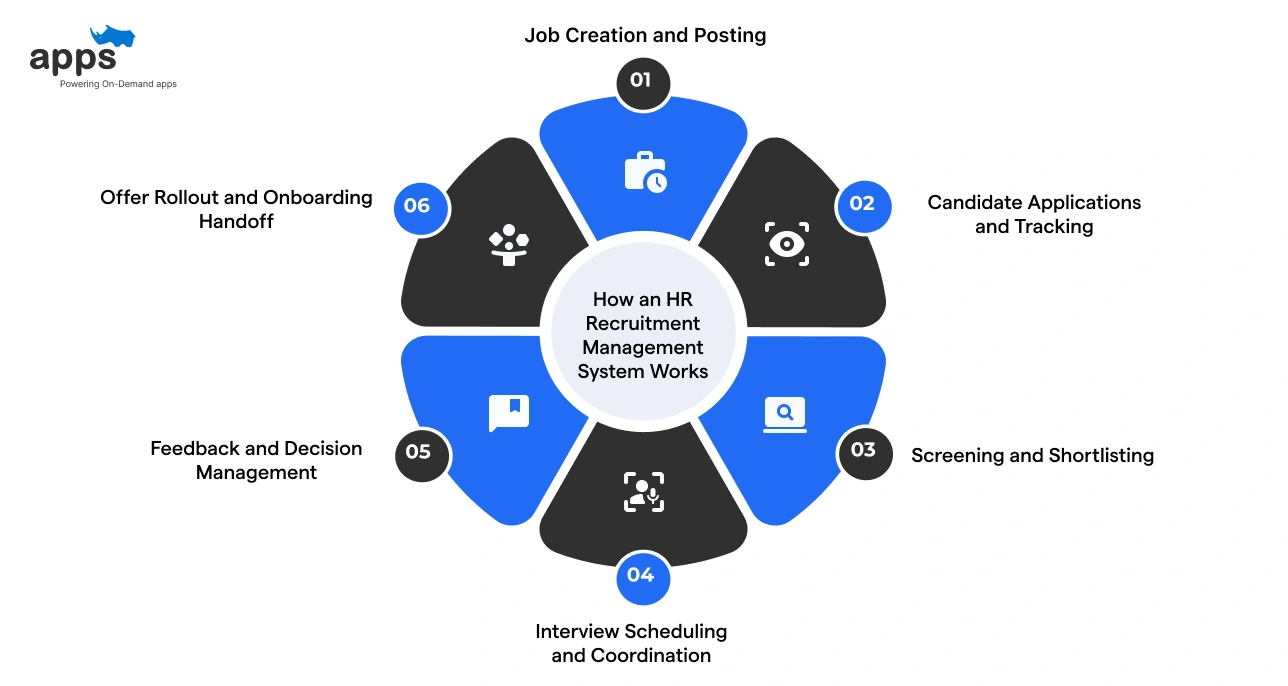
Once hiring picks up pace, things either get organised or chaotic. An HR recruitment management system provides structure by guiding every hiring step through a single, connected flow rather than a scattered set of tools. Let’s see how.
Hiring starts by creating a role once and publishing it across multiple job posting platforms. This keeps job details consistent and saves recruiters from manually updating listings across platforms.
All applications are routed to a central applicant tracking system. Resumes, statuses, and notes stay organised, making candidate management easier and more transparent for everyone involved.
The system helps filter candidates based on skills, experience, and role criteria. This narrows the talent pipeline early and keeps the hiring funnel focused on quality.
Interview scheduling is automated with shared calendars and reminders. Recruiters and hiring managers avoid back-and-forth emails and missed meetings.
To further streamline communication, teams can also use a shared mailbox to manage candidate conversations centrally, ensuring no messages are missed and responses remain consistent across the hiring process.
Interview feedback is collected in one place and tied to each candidate profile. This improves candidate experience and ensures decisions are based on data, not memory.
Once a candidate is selected, details move directly into the employee onboarding systems. The recruitment lifecycle connects smoothly with human resources management.
With the workflow clear, it becomes easier to compare this system with other hiring tools.
Once you understand how an HR recruitment management system works, the pattern becomes familiar. Hiring usually feels manageable… until it doesn’t. At first, a few resumes in your inbox and some calendar invites work just fine.
Then hiring picks up, feedback gets delayed, candidates go silent, and suddenly everyone’s asking, “Where are we with this role?” That’s when teams realise they need more than ad-hoc tools.
An HR recruitment management system becomes worth investing in when hiring starts affecting speed, quality, or candidate experience.
You’re likely at that stage if:
If any of this sounds familiar, HR recruitment management software helps bring order through recruitment automation and structured candidate management.
Now comes the important part: understanding how recruitment systems differ from ATS and HRMS.
Hiring tools often get mixed up because they overlap, but they solve very different problems.
Understanding how an HR recruitment management system, ATS, and HRMS differ helps teams choose the right solution.
| Factor | HR Recruitment Management System | ATS | HRMS |
| Primary focus | Manages the complete recruitment lifecycle end-to-end | Tracks applicants during hiring stages | Manages employee data after hiring |
| Hiring coverage | Covers sourcing, screening, interviews, offers, and onboarding | Limited to applications and interview stages | Minimal hiring features, if any |
| Automation level | Strong recruitment automation across workflows | Basic automation for tracking and status updates | Focuses on HR tasks, not hiring workflows |
| Candidate management | Full candidate management and talent pipeline visibility | Resume tracking and applicant status only | Not designed for candidates |
| Interview scheduling | Built-in interview scheduling and feedback management | Often manual or partially automated | Rarely included |
| Recruitment analytics | Tracks recruitment metrics across the hiring funnel | Basic reporting on applications | Focuses on workforce and payroll reports |
| HR integration | Connects hiring directly with HR and onboarding systems | Works mostly as a standalone tool | Handles human resources management post-hire |
| Best suited for | Teams scaling hiring and needing structure | Teams handling low-volume hiring | Teams managing existing employees |
In short, an ATS helps you track applicants, and an HRMS helps manage employees. An HR recruitment management system sits in the middle, connecting both worlds.
Next, let’s look at the core features that make recruitment management software actually work in real hiring environments.
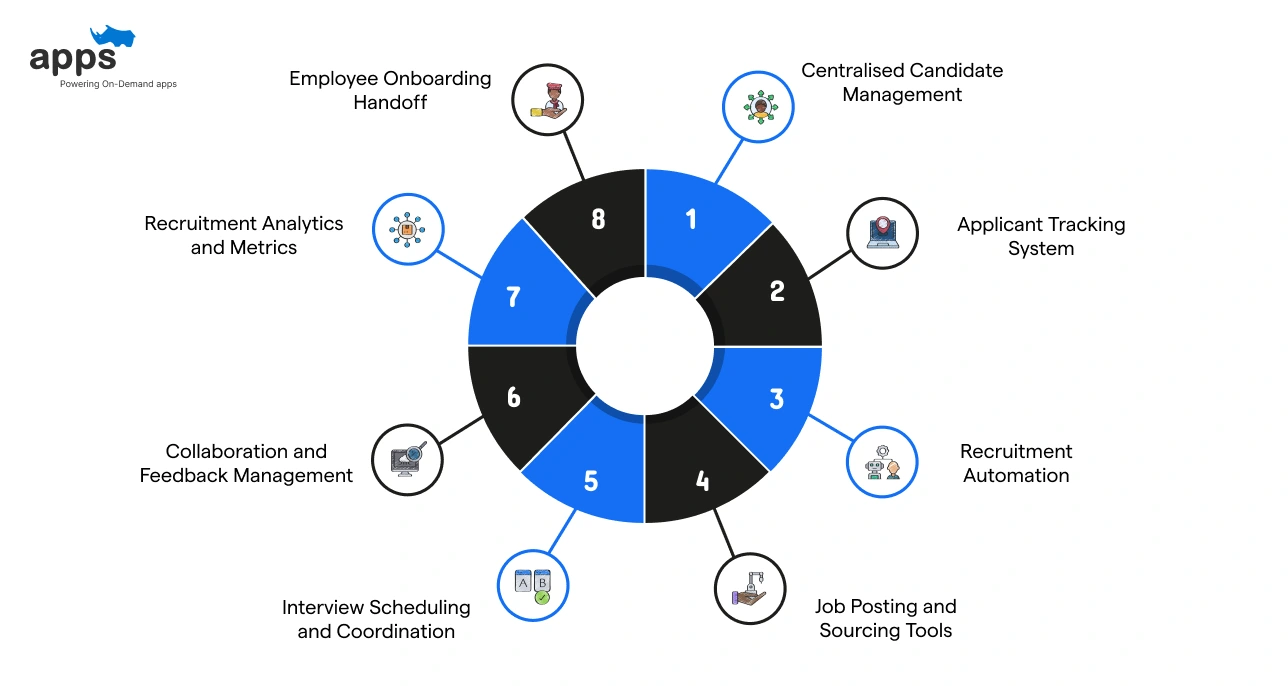
Each feature plays a specific role in keeping the hiring workflow clear, repeatable, and scalable as teams grow. Below are the core capabilities that define effective hr software for recruitment management and why they matter in real hiring scenarios.
All candidate details, such as resumes, interview notes, communication history, and evaluations, live in one place.
This gives recruiters and hiring managers a single source of truth, keeping the talent pipeline organised and easy to track.
It also prevents context loss when candidates move across stages or teams.
An embedded applicant tracking system visually maps candidates through each stage of the hiring funnel.
Recruiters can instantly see where candidates stand, what actions are pending, and where delays are happening.
This brings structure to the recruitment lifecycle without relying on spreadsheets or manual updates.
Routine tasks such as resume shortlisting, follow-up emails, and status updates are handled automatically.
Recruitment automation reduces manual effort and ensures no candidate slips through the cracks.
It also keeps the hiring workflow moving even when recruiters are managing multiple roles.
Open roles can be published across multiple job posting platforms from a single dashboard.
This widens the reach of talent acquisition while keeping job descriptions consistent across channels.
Recruiters save time and gain better visibility into which sources bring quality candidates.
Interview scheduling is streamlined with calendar syncing, availability matching, and automated reminders.
This eliminates long email threads and reduces scheduling conflicts.
Candidates experience faster responses, which improves overall candidate experience.
Hiring managers and recruiters can share structured feedback directly within the system.
This keeps evaluations objective, visible, and tied to each candidate’s profile.
Better collaboration leads to faster decisions and fewer hiring bottlenecks.
The system tracks recruitment metrics, including time-to-hire, drop-off rates, and source performance.
These insights help teams identify what’s working and what needs improvement.
Recruitment analytics also support smarter workforce planning over time.
Once a candidate is hired, their information is entered directly into the employee onboarding system.
This removes duplicate data entry and ensures a smooth transition from recruitment to human resources management. New hires start with complete, accurate records from day one.
Together, these features turn hiring into a controlled, data-driven process instead of a reactive task.
Next, let’s look at the real business benefits teams see when they adopt HR recruitment management software.
A good HR recruitment management system doesn’t just organise hiring. It delivers measurable gains that impact time, cost, quality, and candidate experience. Here are the key benefits you’ll see of recruiting software with HR management.
According to HRMLess, automating repetitive tasks such as resume screening and interview scheduling can reduce time-to-hire by 30–50% compared with manual processes. Reducing the time from job posting to offer acceptance keeps top talent engaged and less likely to accept other offers.
Recruitment automation reduces reliance on external agencies and expensive manual workflows. By streamlining sourcing and screening, companies often see a 20–30% drop in cost-per-hire through reduced recruiter hours and fewer ad-spend inefficiencies. This means HR teams can do more with tighter budgets.
A positive recruitment journey boosts offer acceptance rates and strengthens employer brand among talent, which is crucial as 58% of candidates report declining offers due to poor process experiences.
Real-time recruitment analytics give visibility into funnels, bottlenecks, and performance. Metrics such as source effectiveness and applicant-to-hire ratios help recruiters refine their talent acquisition and make data-driven decisions rather than relying on guesswork.
According to Feeddough reports, Automated shortlisting and screening help match candidates more accurately to role requirements, often improving the quality of hire by 20–30%. Higher-quality hires can lead to better team performance and reduced early turnover.
A structured hiring workflow ensures every candidate is evaluated consistently. This reduces bias, maintains compliance, and creates a predictable process that scales across departments and roles.
As hiring volume grows, manual systems become a bottleneck. An HR software platform for recruitment management scales effortlessly, handling high volumes of applications without slowing teams or increasing headcount.
Once a candidate is hired, data flows directly into onboarding and other HR systems. This avoids duplicate entries and speeds up time-to-productivity for new employees.
Together, these benefits make hiring faster, cheaper, and more strategic. Next, we’ll explore specific scenarios where an HR recruitment management system delivers the most impact.
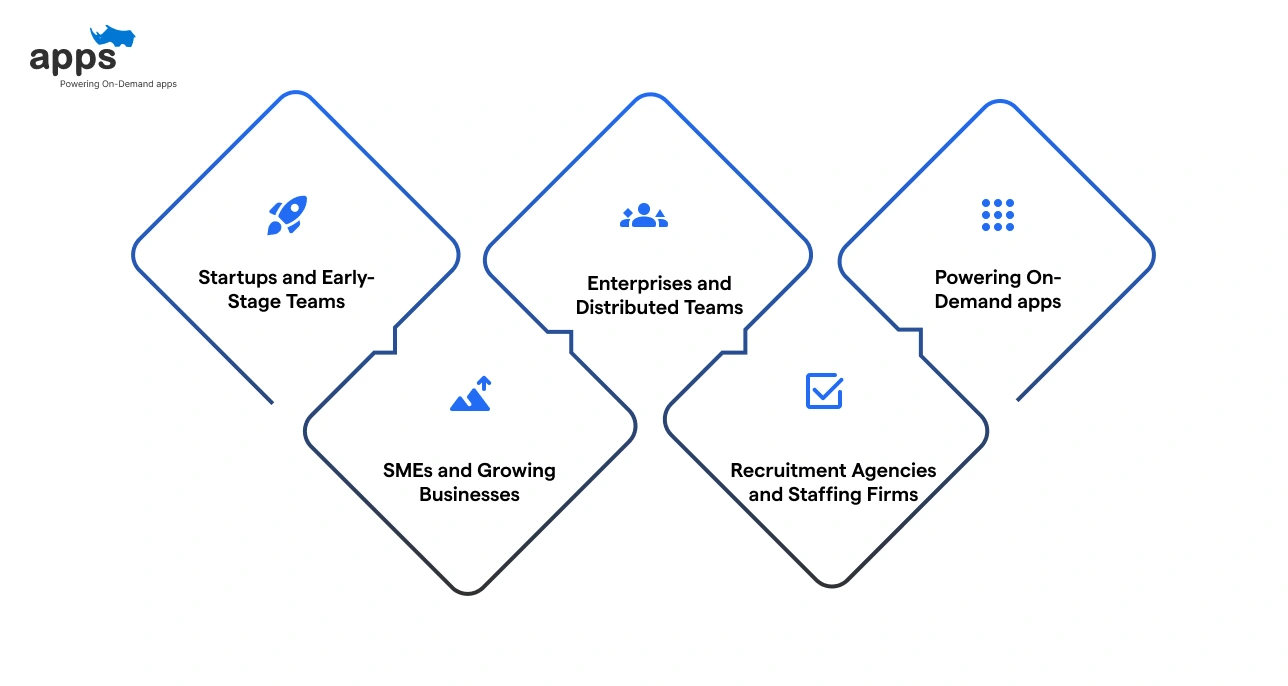
From lean startups to large enterprises, HR recruitment management software adapts to diverse hiring realities while keeping the process structured, trackable, and scalable.
Below are the most common and high-impact use cases where recruiting software with HR management proves its value.
For startups, hiring usually starts small and escalates quickly. An HR recruitment management system helps founders scale hiring without building a full HR department too early.
As SMEs grow, hiring across multiple roles and teams becomes harder to manage manually.
Large organizations need consistency across locations, teams, and hiring managers.
High-volume hiring demands speed, structure, and accuracy.
Some organizations hire less frequently but place a high value on fit and experience.
Across all these scenarios, HR software for recruitment management adapts to how teams actually hire.
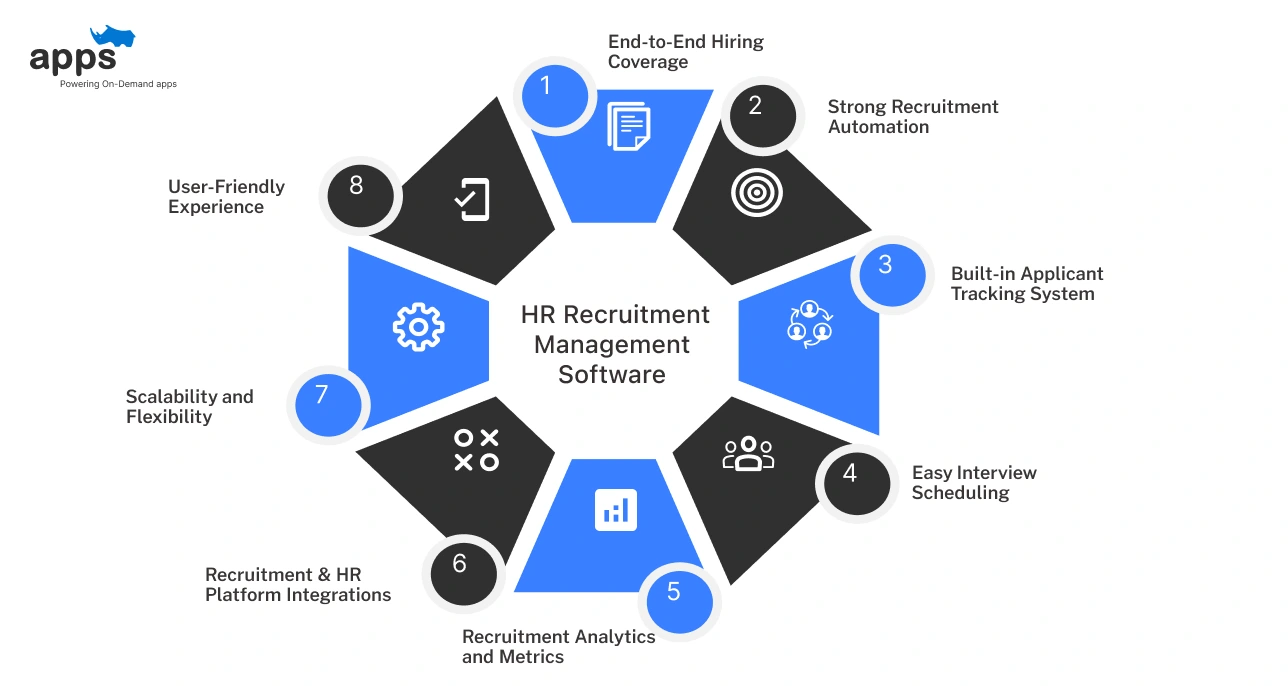
Choosing the right HR recruitment management system is less about fancy features and more about how well it supports real hiring work.
These are the things that actually make a difference once hiring scales. Note these points if you’re considering this recruiting software with HR management.
Getting these elements right ensures your recruitment system works under real pressure.
Up next, we’ll explore when businesses should invest in recruitment management software.
Once you decide that an HR recruitment management system is needed, the real question isn’t if you should invest. It’s how. Do you buy an off-the-shelf tool and adapt your process around it, or do you build a system that adapts to how your hiring actually works?
Building makes sense when hiring is core to how your business operates. Instead of forcing your team into fixed workflows, a custom system is designed around your hiring workflow, roles, and decision-making style.
A built solution lets you:
For teams with unique hiring needs or fast growth, building avoids long-term friction and constant workarounds.
Buying works best when hiring needs are simple and predictable. Off-the-shelf HR recruitment management software offers faster setup and lower upfront effort.
Buying makes sense if:
The trade-off is flexibility. As hiring becomes more complex, teams often find themselves adjusting processes to fit the tool.
Ask yourself a few simple questions:
If the answer is yes more often than no, the building is usually more likely to deliver better long-term value.
Next, let’s look at how businesses bring these systems to life with the right development approach.
Off-the-shelf tools work until they don’t. At AppsRhino, we help businesses build HR recruitment management systems that fit their hiring reality, not the other way around. Every solution is designed around real workflows, growth plans, and long-term hiring goals.
We design hiring workflows based on how your teams actually recruit. From candidate management to interview scheduling, every stage is designed to align with your hiring funnel and decision process.
Recruitment automation is baked into the system from day one. We automate screening, approvals, follow-ups, and status updates to keep the recruitment lifecycle moving without manual effort.
We build applicant tracking systems that don’t stop at resumes. Candidate data stays connected across sourcing, interviews, offers, and employee onboarding without duplication.
Recruitment is directly linked to human resources management tools. Once a hire is made, data flows smoothly into onboarding, payroll, and internal HR technology.
Our systems are built to scale with hiring volume and complexity. Whether you’re hiring ten people or hundreds, the platform adapts without slowing down.
We implement recruitment analytics that track hiring speed, quality, and source performance. These insights support better workforce planning and smarter talent acquisition decisions.
We integrate job posting platforms, calendars, assessment tools, and internal systems. Your recruitment system fits into your existing stack instead of replacing it.
You own the system and its roadmap. No forced upgrades, feature limits, or vendor lock-ins as your hiring needs evolve.
With the right build partner, recruitment systems become long-term assets, not short-term tools.
Up next, let’s wrap everything together and see how to move from planning to action.
Hiring doesn’t need more tools. It needs fewer gaps.
If there’s one thing this blog makes clear, it’s that broken hiring is rarely about talent. It’s about process. An HR recruitment management system brings clarity where inboxes fail, structure where spreadsheets collapse, and consistency where gut feeling takes over.
From candidate management to interview scheduling and recruitment automation, the right system makes hiring repeatable and streamlined.
And when off-the-shelf tools feel limiting, AppsRhino helps you go beyond them.
We design and build custom HR recruitment management software, end-to-end hiring platforms, and scalable business apps tailored to how your teams actually work. From recruitment systems to full custom software, we build what fits.
Custom Development
7 Apr 2026
Tell us what your business actually runs on today, and we will map what it takes to make it one system.