

Custom Development
Alcohol Delivery Market Share and Trends: Size, Growth, & Business Opportunities
7 Apr 2026
Not every business manages to grow without losing its soul. IKEA did.
From a tiny Swedish mail-order venture to a global furniture powerhouse, IKEA has kept its vision clear while scaling fast.
Its success isn’t just about low prices or clever flat-pack designs; it’s a business model built on smart decisions, efficiency, and understanding what customers really want.
Behind each store and every piece of furniture is a system that balances cost, design, and experience.
In this guide, we’ll explore the IKEA business model, its revenue strategy, and the lessons that make it hard for others to replicate it.
IKEA is a global home furnishings brand that offers furniture and home products that are simple, functional, and affordable.
With hundreds of stores across over 50 countries, millions of customers shop at IKEA in-store or online each day, drawn by its design and value.
The following sections unpack the structural pillars that drive this system at scale.
The heart of IKEA’s business model lies in a few key strategies:
IKEA’s journey to a global retail giant shows the power of smart systems and customer-focused design.
For modern brands, building that kind of scalable, omnichannel experience requires more than great products: it demands the right digital infrastructure.
Businesses looking to replicate this efficiency often partner with custom app development teams like AppsRhino to create tailored ecommerce platforms and furniture apps that deliver seamless user experiences.
IKEA’s success comes from a business model that’s simple to understand but hard to copy.
Using the Business Model Canvas, IKEA creates value, reaches customers, and runs its operations efficiently.
Each piece of the puzzle explains why it works at scale:
This structure makes IKEA affordable and stylish while keeping operations smooth, consistent, and scalable worldwide.
IKEA makes money in more ways than just selling furniture.
Its total revenue helps the company invest in stores, online systems, and new experiences for customers.
In FY25, IKEA’s global retail sales reached about €44.6 billion, showing its massive scale even as it adjusts prices and expands ecommerce and services. (Source: IKEA)
Here are the multiple ways in which IKEA makes money:
The IKEA business plan thus strategically balances low prices with volume growth, helping it stay competitive and profitable worldwide.
Besides the primary revenue streams covered, there are a few financial engines that are often overlooked in IKEA’s model. These include:
Together, these revenue streams show that IKEA’s success comes from a carefully designed system where products, services, digital channels, and even real estate all work together to drive consistent growth and profitability.
Every product price at IKEA is carefully planned to stay affordable while keeping the business profitable.
The table below breaks down the IKEA business model and pricing strategy for long-term cost leadership:
These strategies make IKEA’s pricing sustainable, scalable, and difficult for competitors to copy, keeping furniture stylish, functional, and affordable worldwide.
Behind every low price and stocked shelf is a tightly managed system.
From sourcing raw materials to delivering flat-pack products, IKEA focuses on efficiency, agility, and reliability across markets.
IKEA sources materials and products from suppliers across multiple countries.
This spreads risk and decreases costs. Long-term contracts help secure stable pricing and a steady supply.
The company works closely with thousands of suppliers.
It sets clear standards for cost, quality, and sustainability. Strong relationships improve reliability and reduce disruptions.
Flat-pack design makes storage easier and cheaper.
Warehouses are optimized for volume. Smart inventory systems track stock and reduce waste.
Automated systems, optimized transport routes, and bulk shipping keep products moving efficiently.
The “e-wheel” sustainability tool tracks environmental impact across raw materials, production, distribution, use, and end-of-life.
Notably, IKEA aims to cut transport emissions significantly and transition toward zero-emission vehicles by 2040.
Store layouts guide customers through curated spaces.
Online, in-store, and click-and-collect systems work together to create a smooth buying experience.
On the whole, these tightly connected operations allow the brand to control expenses, grow efficiently, and deliver a consistent customer experience across every market it serves.
IKEA has built a strong digital layer that supports how people browse, plan, and buy.
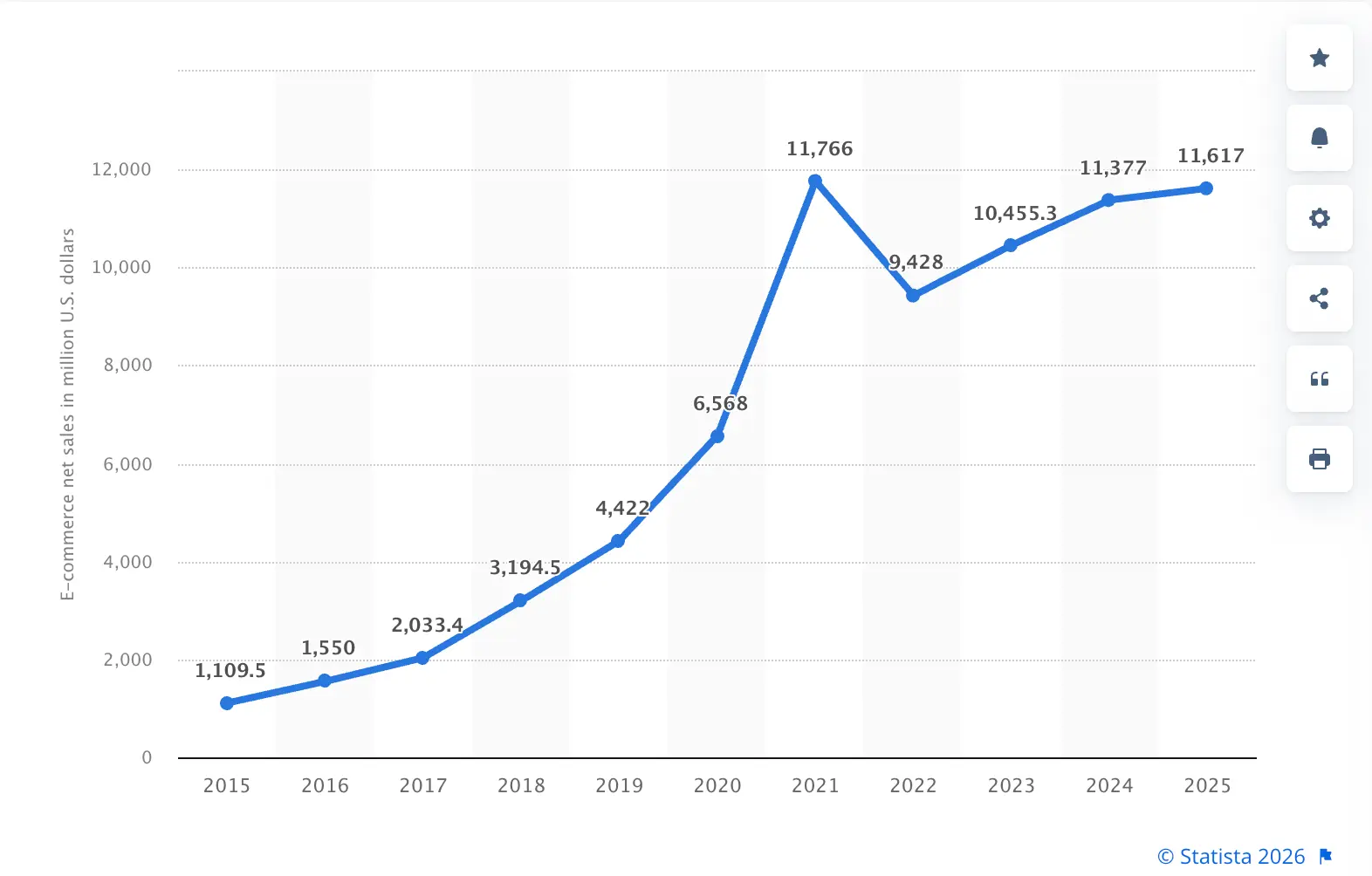
Ecommerce is now central to how the brand grows and serves modern customers. In fact, in 2025-26, the furniture industry giant is reported to have created around $11.6 billion in ecommerce net sales worldwide. (Source: Statista)
The core components of IKEA’s digital growth include:
IKEA’s website and mobile app act as full digital storefronts.
Customers can explore products, check stock, save wishlists, and plan rooms. The experience mirrors the in-store journey but adds convenience.
Online orders have increased steadily as more shoppers prefer home delivery.
Ecommerce helps IKEA reach customers beyond physical store locations.
Click and collect blends digital and physical retail.
Customers order online and pick up in-store, saving delivery time and cost.
Tools like AR let shoppers visualize furniture in their homes before buying.
This reduces hesitation and returns.
IKEA also offers connected home products, from smart lighting to speakers, expanding beyond traditional furniture.
Online and offline channels now work together.
This integrated approach strengthens customer experience and long-term growth.
These digital capabilities have transformed IKEA ecommerce into an ever-growing revenue and growth engine, expanding reach, improving convenience, and increasing revenue across markets.
Many companies aiming to scale their digital commerce operations look to partner with experienced product teams.
AppsRhino supports this shift by enabling brands to create smooth, omnichannel buying experiences that drive long-term growth.
Some brands can copy IKEA’s prices. Some copy its store layout. But copying a few tactics is easy. Rebuilding the full system behind it is not.
Owing to its structural merits, IKEA has built a defensible business model that keeps it ahead of competitors.
IKEA’s edge comes from deep structural strengths built over decades. These are not quick wins. They are long-term advantages.
These strengths connect. That is what makes them hard to copy.
Suggested Reading :Top 10 Ikea App Features You Must Consider: Quick Guide
There are clear lessons here for any growing business. The model shows how discipline creates long-term advantage.
Thus, IKEA’s strength is not one idea; it is a well-built system.
IKEA did not grow by accident. It grew by making deliberate choices and sticking to them.
Every part of the IKEA business connects. Design supports pricing. Pricing supports volume. Volume strengthens the supply chain. The system feeds itself.
The brand shows that low cost does not mean low value. It proves that simplicity, when done well, can scale globally.
Flat-pack design, disciplined sourcing, and strong ecommerce all reinforce the same goal.
In the end, IKEA’s advantage is not hype. It is structure, patience, and consistency. That is what makes the model last.
Custom Development
7 Apr 2026
Tell us what your business actually runs on today, and we will map what it takes to make it one system.