
Custom Development
Alcohol Delivery Market Share and Trends: Size, Growth, & Business Opportunities
7 Apr 2026
Food delivery has always been popular, but its growth accelerated dramatically after the pandemic.
Even with major platforms like Uber Eats, DoorDash, and Grubhub dominating the market, the industry still leaves room for new ideas and niche-focused services.
This makes food delivery app development an attractive opportunity for businesses that want to enter the on-demand economy.
However, success requires more than just launching an app. It involves understanding the right business model, features, and development approach.
In this guide, we explore the fundamentals of building a successful food delivery application, including key models, essential features, and the estimated cost of food delivery app development, to help you plan effectively.
Food delivery app development is the process of designing, building, and deploying a platform that connects customers, restaurants, and delivery partners in real time.
A complete platform includes four components: a customer-facing app, a restaurant management panel, a delivery partner app, and an admin dashboard.
Customized development means building for your specific business model, not deploying a white-label template. When you develop a food delivery app from scratch, the features, flows, and integrations are designed around your market and your operations.
Food mobile app development at this level requires decisions about architecture, platform, team structure, and integrations, all covered below.
Your business model shapes how your food delivery platform operates, earns revenue, and scales. Take a moment here, your model is the foundation on which everything else is built.
Let’s take a quick look at the main models.
A platform lists multiple restaurants, while each restaurant handles its own delivery operations. The platform typically earns through commissions, listing fees, and promotional placements.
A single restaurant brand builds its own ordering and delivery application for direct customer orders. This model gives full control over branding, pricing, and customer data.
The platform manages the entire delivery ecosystem, including restaurant partnerships, order management, and its own delivery fleet.
It offers complete operational control but requires higher investment and logistics management.
A combination of platform-managed delivery and restaurant-managed delivery, depending on the location or order type.
This flexible model allows platforms to expand operations without immediately building a full delivery fleet.
Now that you understand the business models, the next step is identifying the essential features required to build a successful food delivery app.
Building a successful platform means designing features for every user involved. Let’s break down the essential capabilities each role needs.
| Role | Key Features |
| Customer App |
|
| Restaurant Panel |
|
| Delivery Partner App |
|
| Admin Dashboard |
|
With these core features in place, the next step is to understand how to build the platform and structure the development process.
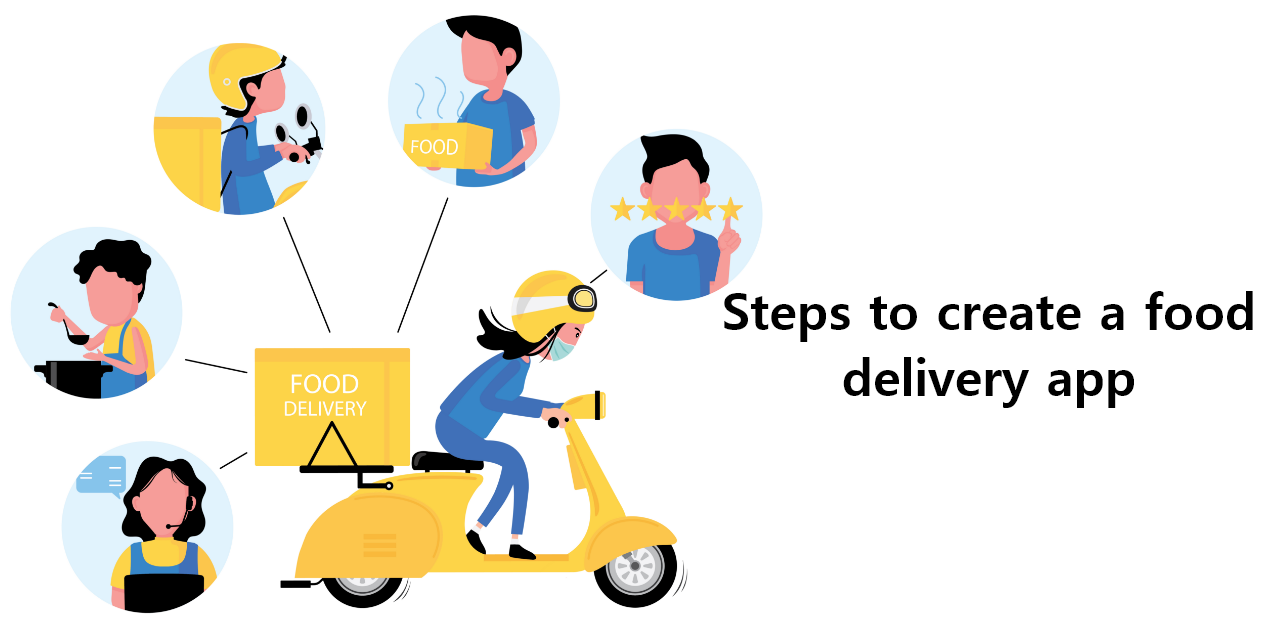
Building a successful platform takes more than just writing code. It requires a clear process, the right planning, and strong execution.
Let’s walk through the key steps involved in food delivery app development and how successful platforms are built.
Before writing a single line of code, validate the idea. Talk to restaurant owners, study local competitors, and evaluate delivery demand in your target region.
This step ensures your development project solves a real problem and avoids costly mistakes later.
Map user journeys for customers, restaurants, delivery partners, and administrators. Create wireframes and prototypes, then test them with real users before development begins.
Adjusting flows during design is far faster and cheaper than changing them during development.
This stage builds the core system that powers orders, payments, notifications, and live delivery tracking.
A reliable backend, combined with scalable mobile app development frameworks like Flutter or React Native, helps launch faster while supporting future growth.
Testing should simulate real usage scenarios such as peak orders, slow networks, and payment failures.
Continuous QA ensures the platform works smoothly across devices and prevents issues that could impact user experience after launch.
Begin with a soft launch in a limited region to monitor performance and gather feedback.
This phased approach allows teams to fix issues quickly before scaling the platform to larger markets.
Tip: Finalize features and scope early. Changes during development can significantly increase the overall cost of app development and delay the launch timeline.
The first question most founders ask is simple: how much does the development cost? The answer depends on features, scale, and the type of platform you plan to build.
Take a look below at the typical development cost ranges for different types of food delivery apps in 2026.
| App Type | Estimated Cost Range (USD) | Timeline |
| Basic MVP | $20,000 – $45,000 | 3–4 months |
| Mid-Level App | $50,000 – $110,000 | 4–7 months |
| Enterprise Platform | $120,000 – $300,000+ | 8–12+ months |
An MVP usually includes core ordering, payments, basic tracking, and simple admin tools. Mid-level apps add stronger UI, integrations, and improved dashboards, while enterprise platforms support multi-city operations, fleet management, and advanced analytics.
For a single restaurant or small delivery operation, the cost to develop a pickup-and-delivery app typically ranges from $20,000 to $50,000 for a cross-platform MVP.
In practice, the cost of developing a food delivery app depends largely on scope, team location, and the complexity of the platform you plan to build.
Understanding how much it costs to make an app for a restaurant compared with a full marketplace or aggregator is an important first step, because each model requires very different development resources and budgets.
Several factors influence a project's final budget.
Let’s take a look at the key elements that impact food delivery app development costs and overall technology requirements.
| Factor | Typical Pricing Impact (2026) | Cost Impact |
| Developer Region | $25–$45/hr (India) vs $120–$200/hr (US) | Development location can create a 3–5× difference in total project cost. |
| Platform Choice | +35–45% for native iOS + Android | Cross-platform builds usually reduce early development cost. |
| Third Party Integrations | $2,000–$8,000 per integration | Payments, maps, analytics, and notifications expand the scope of development. |
| UI/UX Design | $5,000–$15,000 for custom UI | Custom flows and branding improve usability but increase design effort. |
| Feature Scope | +$5,000–$20,000 per major feature | Real-time tracking, loyalty systems, or AI recommendations add development time. |
Understanding these factors early helps founders estimate the costs more accurately and avoid expensive changes later in the project.
Budgeting for 2026? Explore food delivery app development costs to ensure your financial roadmap is as solid as your business plan
Development location is not just a pricing factor. It directly affects the overall cost of app development and project scalability.
Let’s look at typical hourly rates in 2026.
| Region | Hourly Rate (2026) | Estimated Project Cost (Mid-Level App) |
| USA / Canada | $100 – $250/hr | $120,000 – $250,000+ |
| Western Europe | $80 – $160/hr | $100,000 – $180,000 |
| Eastern Europe | $40 – $90/hr | $50,000 – $110,000 |
| India / SE Asia | $25 – $55/hr | $30,000 – $85,000 |
The developer's location significantly affects the total cost of food delivery app development.
Many startups choose development teams in India to balance quality and budget, while US-based development for a mid- to advanced platform typically ranges from $80K to $200K.
To optimize both quality and cost, many companies now adopt a hybrid approach where product strategy is handled in the US or Europe and development is executed by offshore teams.
Many founders ask what it costs to build platforms similar to today’s market leaders.
Let’s take a quick look at the typical development investment for apps with similar capabilities in 2026.
| Platform Reference | Estimated Build Cost (2026) |
| Uber Eats–like App | $90,000 – $130,000 |
| DoorDash–like App | $100,000 – $180,000 |
| Rappi–like App | $120,000+ |
Of course, not every platform needs this level of complexity. Let’s now look at the technology stack that powers modern food delivery apps.
Note: These figures represent general development estimates based on current industry benchmarks and may vary depending on specific business requirements and technology choices.
Technology choices directly impact performance, scalability, and long-term maintenance costs.
Let’s take a look at the core technologies used when building a food delivery mobile app.
With the technology foundation clear, the next question founders usually ask is: how long does it actually take to build a food delivery app.
Development timelines vary depending on the scope, integrations, and overall platform complexity. A simple MVP can launch faster, while multi-vendor platforms naturally take longer to build.
Have a look at the typical development timeline below to understand how the process usually unfolds.
| Development Stage | Timeline |
| Discovery & Wireframing | 1–2 weeks |
| UI/UX Design | 2–4 weeks |
| Backend + Mobile Development | 3–6 months |
| API Integrations | 2–4 weeks |
| Testing & QA | 2–4 weeks |
| Deployment & Soft Launch | 1–2 weeks |
A lean MVP ships in 3–4 months with a focused team.
A full-featured platform with multi-vendor support takes 6–9 months. The biggest timeline killers: scope changes after development begins and integration complexity that wasn't scoped up front.
With the timeline clear, the next step is to explore practical strategies to reduce overall development costs without compromising quality.
Building a food delivery app can quickly become expensive if the scope expands too early.
With the right planning and development approach, you can reduce development costs while maintaining quality.
These tips will help you control development costs while building a strong foundation for future platform growth.
Food delivery platforms are evolving quickly as technology reshapes customer expectations and logistics operations. These innovations also highlight the growing scope of food delivery app development over the next decade, as new technologies continue to expand what delivery platforms can offer.
In 2026, AI-powered recommendation engines are becoming more predictive, using order history, time of day, and behavioral patterns to suggest meals before users even search.
Machine-learning-driven route optimization is helping platforms reduce delivery times while lowering drivers' fuel costs. Meanwhile, drone and autonomous delivery pilots from companies like Amazon Prime Air and Alphabet’s Wing continue to expand in controlled commercial zones.
Voice ordering through smart assistants and in-car systems is also growing for repeat purchases. Another major trend is hyperlocal delivery, where dark store networks enable deliveries within 10–15 minutes.
Sustainability is also gaining attention, with platforms introducing eco-friendly packaging and carbon-neutral delivery options in major cities.
Understanding the business model is easier when you know why businesses invest in food delivery apps in the first place.
Selecting the right partner for your business can determine whether your platform launches smoothly or struggles during development.
Let’s walk through the key questions you should ask before choosing a team for food delivery app development.
Ask for live app links instead of presentation decks. Review real products and, if possible, speak with previous clients.
Have they built features like real-time tracking, multi-role dashboards, and payment integrations before? General software experience is not the same as on-demand food delivery app development.
Check whether they build using modern frameworks or rely on proprietary systems that create long-term lock-in.
Look for clear sprint cycles, weekly demos, transparent backlogs, and a single point of contact managing the project.
Confirm what food delivery app development services include after deployment, such as updates, monitoring, and feature improvements.
Ensure the proposal outlines development scope, hourly rates, and change policies to avoid unexpected costs later.
Choosing the right partner becomes easier when you evaluate development companies based on what they have actually shipped, not just what they promise.
If you’re considering custom food delivery app development, the key is choosing a team that understands both the technology and the business behind delivery platforms.
The right partner should help you plan features, estimate the cost and build a scalable product that fits your business model.
Experienced companies usually focus on:
Teams like AppsRhino work with businesses to develop food delivery apps aligned with their operational goals rather than using fixed templates.
The focus stays on building reliable platforms that can grow with your users and delivery operations.
Building a successful food delivery platform requires more than just developing an app. It starts with choosing the right business model, identifying essential features, and building a product that solves a real customer problem.
The most successful platforms are rarely the most complex at launch. Instead, they begin with a focused product, validate their idea in the market, and improve continuously based on real user feedback.
Approaching food delivery app development with a clear strategy, scalable technology, and a phased rollout helps reduce risk and improve long-term success.
With the right planning and development partner, businesses can launch platforms that are reliable, efficient, and ready to grow as demand increases.
Custom Development
7 Apr 2026
Tell us what your business actually runs on today, and we will map what it takes to make it one system.