
Custom Development
Alcohol Delivery Market Share and Trends: Size, Growth, & Business Opportunities
7 Apr 2026
The most profitable delivery businesses today don't rely on someone else's app; they own the entire operation. That distinction matters more than most people realize.
When you hand your orders to a third-party platform, you're not just losing margin; you're losing customer data, brand control, and long-term leverage. The businesses scaling fastest right now made one critical decision early: they built their own infrastructure.
Knowing how to create a food delivery app isn't a purely technical conversation anymore. It sits at the intersection of operations, technology, and business strategy.
This guide breaks down the full picture from foundational decisions to execution, covering business models, platform planning, restaurant onboarding, delivery operations, and launch strategy so you can build with clarity and confidence, not guesswork.

Online food delivery has moved from convenience to everyday infrastructure for restaurants and consumers. Ordering meals through mobile apps is now a normal behavior in most urban markets.
In regions like the food delivery app in USA, customers expect fast ordering, real-time tracking, and reliable delivery. This shift has created a strong opportunity for startups and established businesses looking to start your own food delivery business.
Several factors are driving this growth:
Because of these shifts, entrepreneurs exploring how to start a food delivery service or how to start a delivery business no longer need to build everything from scratch.
Many founders begin with an MVP to build a delivery app, validate demand, and then scale into a full food delivery platform with restaurant partnerships and delivery operations.
The market demand already exists. The real opportunity lies in identifying a focused niche and building a platform that delivers consistent value for restaurants and customers.
A food delivery service is not just a mobile app. It is a connected ecosystem where multiple users interact through a single platform.
Anyone exploring how to start a food delivery app business must understand this structure first. The snapshot below shows the core components.
Quick Table Snapshot
| Platform Component | Primary Users | Key Features |
| Customer App | Customers ordering food | Restaurant discovery, menu browsing, checkout, real-time order tracking, notifications |
| Restaurant Dashboard | Restaurant owners and staff | Order management, menu updates, preparation time control, sales tracking |
| Delivery Partner System | Delivery drivers | Order alerts, route navigation, delivery status updates, availability controls |
| Admin Platform | Platform operators | Restaurant onboarding, driver management, commission settings, analytics, and reporting |
Each component plays a specific role in the marketplace. Let’s look at how these systems function in more detail below.

The customer app is where users browse restaurants, explore menus, place orders, and track deliveries. It focuses on convenience and speed.
Customers expect simple search, quick checkout, and real-time updates. When founders research how to make your own food delivery app, this is usually the most visible part of the platform because it directly shapes the customer experience.

The restaurant dashboard allows partner restaurants to manage orders and menus.
Restaurants use this panel to accept or reject orders, update menu availability, set preparation times, and monitor sales. A well-designed dashboard helps restaurants operate smoothly without interrupting their kitchen workflow.
Delivery partners rely on a dedicated interface to receive orders, navigate routes, and update delivery status.
The system assigns orders based on proximity, availability, and delivery zones. Efficient routing and driver management are critical for maintaining fast delivery times.
The admin platform is the operational center of the entire system. It helps platform operators manage restaurants, delivery partners, payments, and commissions. It also provides analytics on orders, revenue, and platform performance.
This central control layer is essential for anyone planning to build a delivery app, because it ensures that the entire marketplace operates smoothly and scales efficiently.

Launching a delivery platform requires structured decisions across business, operations, and technology. Follow the steps below to move from idea to launch.
Start with a clear market gap. This could be hyperlocal delivery, office lunches, healthy meals, or late-night delivery.
A focused niche helps founders start your own food delivery business with a clear value proposition instead of competing broadly from day one.
Your model determines how orders are fulfilled and who manages delivery. Common options
include aggregator platforms, restaurant-managed delivery, or hybrid logistics.
Anyone researching how to start a delivery service app should evaluate operational complexity before choosing a model.
Most platforms earn through restaurant commissions, delivery fees, and featured listings.
Strong revenue planning ensures your food delivery platform stays profitable as order volumes grow.
Before building anything, define the core capabilities needed across customer ordering, restaurant management, delivery tracking, and admin controls.
These early delivery app requirements shape how the product will function once it launches.
Once requirements are clear, teams move into product creation. This stage includes design, backend systems, integrations, and testing.
For founders exploring how to create a food delivery app, this is where technology partners or product teams begin development.
Restaurants are the supply side of the marketplace. Start with a small group of trusted partners and help them digitize menus and order workflows.
Strong restaurant relationships make the platform more attractive to customers from the beginning.
Reliable delivery operations are critical for user experience. Platforms usually start with gig drivers or local delivery fleets.
Clear onboarding and route management systems ensure orders move efficiently from restaurants to customers.
Most successful platforms begin with a single city or neighborhood before expanding.
This early launch phase validates demand and provides insights that help refine the food delivery app development process before scaling further.
Following these steps helps founders move from concept to launch with a clear roadmap, turning a simple app idea into a functioning delivery business.
At this stage, execution speed is everything.
Building from scratch is possible, but it is rarely the smartest use of early resources. Most founders who launch fast don't start with a blank canvas.
That's where platforms like AppsRhino come in, with purpose-built delivery infrastructure, ready integrations, and operational tools that get you to launch faster.
Delivery logistics are what keep the entire operation moving smoothly.
Behind every order is a system that decides who delivers it, how fast it moves, and how efficiently routes are managed.
Driver assignment determines which delivery partner receives an order. Most platforms assign orders based on driver proximity, availability, and delivery load.
A well-designed assignment system reduces wait times for restaurants and ensures customers receive their orders quickly, which is critical when launching a food delivery app.
Routing systems guide drivers from the restaurant to the customer using optimized navigation paths. These systems typically rely on real-time traffic data and map integrations.
Efficient routing helps reduce delivery delays and improves the overall experience for both drivers and customers as the platform scales.
Order batching allows platforms to combine multiple nearby orders into a single delivery trip. A driver can pick up several orders from the same area and deliver them in sequence.
This improves delivery efficiency and lowers operational costs as order volume increases.
Delivery zones define the geographic areas where your platform accepts and processes orders. Each zone helps control delivery distance and manage driver availability.
Clear zones help maintain consistent delivery times and allow platforms to expand gradually into new areas.
Strong delivery logistics systems ensure the platform operates smoothly as demand grows, making them essential for scaling a modern food delivery platform.
A delivery platform generates revenue through multiple streams tied to orders, restaurants, and customer usage.
The common monetization models are summarized in the table below.
| Revenue Model | How It Works |
| Commission from Restaurants | Platforms charge restaurants a percentage on every order placed through the app. This is the primary revenue source for most delivery platforms and scales with order volume. |
| Delivery Fee | Customers pay a delivery charge based on distance, order value, or demand. This helps cover logistics costs and driver payouts. |
| Advertising & Featured Listings | Restaurants can pay for promoted placement inside the app to appear higher in search results or featured sections, increasing their visibility to customers. |
| Subscription Programs | Platforms offer memberships that offer benefits such as free delivery or exclusive deals. This creates recurring revenue while improving customer retention. |
For founders evaluating the business model of a delivery platform, combining multiple revenue streams helps build a sustainable, scalable marketplace.
Launching a delivery platform involves more than just building the product. Founders should plan for several operational and growth-related costs before entering the market.
Key cost areas are outlined below.
Marketing drives early adoption and helps attract both customers and restaurant partners.
These activities help generate early traction and build the initial customer base.
Logistics costs support the delivery network that moves orders from restaurants to customers.
Efficient logistics systems help maintain delivery reliability and customer satisfaction.
Operations ensure the marketplace runs smoothly and restaurant partners stay active on the platform.
Strong operational support helps maintain restaurant relationships and service quality.
Understanding where your money goes is only half the equation. Knowing how to earn it back is what determines long-term viability.
See How Food Delivery Apps Make Money: Revenue Models for a full breakdown.
Technology costs cover the infrastructure that keeps the platform running after launch.
Reliable technology systems ensure the platform operates smoothly as order volume grows.
Launching a delivery marketplace involves more than technology. Founders must manage supply, demand, and operations simultaneously.
Here are some common challenges and how businesses typically address them.
Attracting the first set of customers can be difficult when the platform is new and lacks brand recognition.
How to overcome it: Focus on a specific city or niche, offer introductory promotions, and partner with local restaurants to build early demand.
Without enough restaurants on the platform, customers will not see value in using the service.
How to overcome it: Start by onboarding a small group of trusted restaurants, offering competitive commission terms, and providing easy menu setup.
Maintaining a reliable pool of delivery partners is essential for consistent service.
How to overcome it: Offer flexible work options, fair payouts, and clear onboarding processes to ensure drivers stay active on the platform.
Delays in delivery can quickly affect customer satisfaction and retention.
How to overcome it: Use optimized routing systems, define delivery zones clearly, and monitor driver performance regularly.
In the early stages, platforms often struggle to balance customer orders with the availability of restaurants and drivers.
How to overcome it: Launch in a limited geographic area and gradually expand as order volume stabilizes.
Running a marketplace involves managing restaurants, drivers, customer support, and payments simultaneously.
How to overcome it: Build clear workflows and automation tools early, especially if you plan to make your own delivery app and manage operations internally.
Understanding these challenges helps founders plan better when starting a food delivery app, ensuring the platform grows sustainably as demand increases.
Scaling a delivery marketplace requires more than adding users. Sustainable growth depends on expanding supply, improving logistics, and strengthening the customer experience.
Once operations stabilize at one location, the next step is to enter nearby cities with similar demand patterns. Expansion usually works best when restaurants, drivers, and marketing efforts are launched together.
Impact: Expanding city by city helps the food delivery platform grow steadily without overwhelming operations.
As order volume grows, platforms must improve how drivers are assigned, routed, and scheduled. Smart dispatch systems reduce idle time and improve delivery speed.
Impact: Optimized driver allocation improves order fulfillment and maintains consistent delivery times as demand increases.
Platforms can use ordering history, cuisine preferences, and time-based patterns to suggest meals customers are more likely to order.
Impact: Personalized recommendations increase repeat purchases and help restaurants generate more consistent orders.
Growth depends heavily on the variety and quality of restaurants available on the platform. Expanding restaurant partnerships improves menu diversity and attracts more users.
Impact: A broader restaurant ecosystem strengthens customer retention and helps start a
food delivery app gain long-term traction.
Loyalty rewards, subscriptions, and referral programs encourage repeat ordering and long-term engagement.
Impact: Retention strategies lower acquisition costs and stabilize revenue as the platform scales.
As the platform grows, automation becomes essential for managing orders, support requests, and analytics.
Impact: Automated systems streamline the food delivery app development process from an operational perspective, enabling teams to focus on expansion rather than manual coordination.
Delivery platforms generate large volumes of operational data. Analyzing order patterns, delivery times, and customer behavior helps improve service efficiency.
Impact: Data insights guide smarter expansion decisions for founders planning how to start a delivery service app in new regions or markets.
Scaling a delivery business comes down to logistics, consistency, and getting operations right early. The opportunity ahead is bigger than most expect; the scope of food delivery app development in the next decade makes that clear.

The food delivery industry continues to evolve as technology improves logistics, personalization, and ordering experiences. Platforms are shifting from basic ordering apps to smarter delivery ecosystems.
Some key trends shaping the future include:
Platforms increasingly use AI to recommend meals based on past orders, time of day, dietary habits, and location. These systems help customers discover food faster while improving order frequency.
Many platforms are moving toward 10–15 minute delivery models through localized restaurant clusters and dark kitchens. This reduces delivery distance and improves operational efficiency.
Restaurants are launching delivery-only brands that operate without dine-in spaces. These cloud kitchens allow platforms to expand food variety quickly while reducing infrastructure costs.
Companies are experimenting with drones and autonomous delivery vehicles to reduce delivery times and operational costs. While still developing, these technologies could reshape last-mile logistics.
Ordering through voice assistants, smart TVs, and connected cars is gradually becoming part of the delivery experience. This makes ordering more convenient for repeat customers.
Advanced routing systems now analyze traffic patterns, demand spikes, and driver availability to assign deliveries more efficiently.
These advancements show how the industry is evolving, especially for founders exploring how to build a food delivery app and scale delivery businesses.
Building a successful food delivery business involves more than just developing an app. The platform, integrations, and operational systems all need to work together from day one.
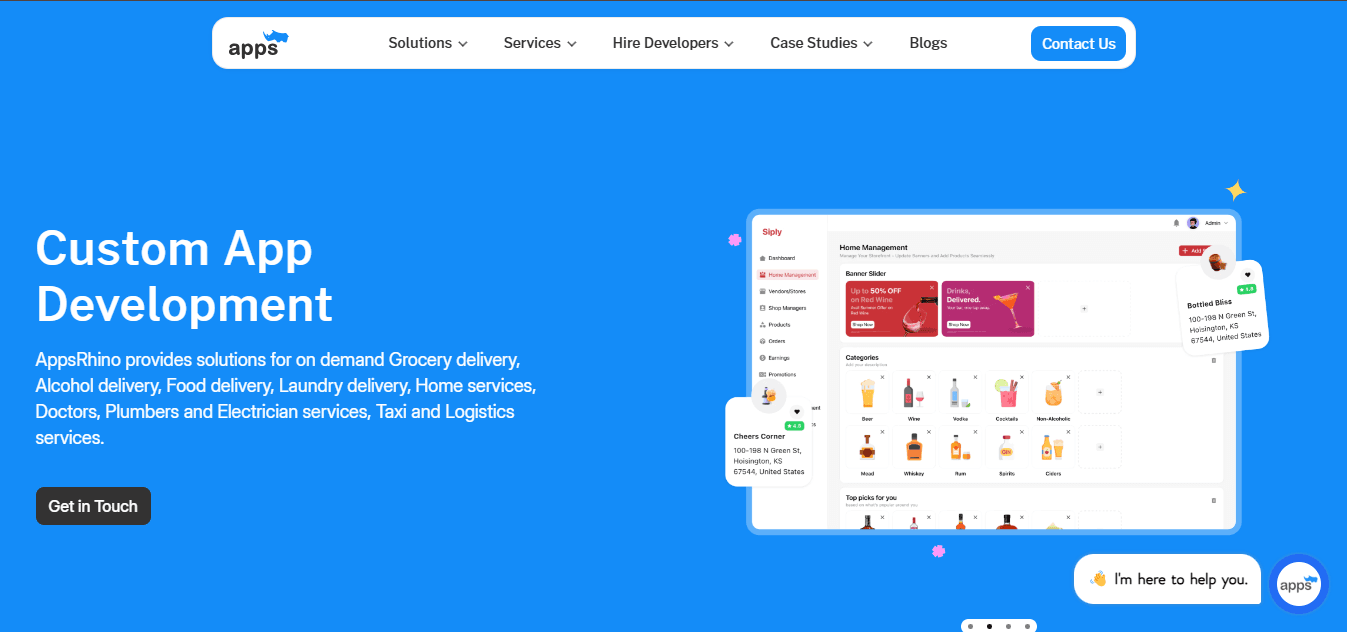
That is where AppsRhino comes in. Instead of spending months setting up infrastructure and integrations, founders can move faster with a delivery-ready platform built specifically for on-demand businesses.
Key advantages include:
For founders exploring how to start a food delivery app and launch it as a scalable delivery business, working with the right technology partner can significantly reduce both time-to-market and operational complexity.
AppsRhino helps transform delivery startup ideas into real platforms that are ready to operate and grow.
A strong food delivery business is shaped by clear strategy, reliable operations, and the right technology foundation. From identifying the right niche to managing restaurants, drivers, and customer experience, every step plays a role in long-term growth.
For founders exploring how to start a food delivery app, success comes from treating the platform as a full business ecosystem, not just a mobile product. Careful planning around logistics, partnerships, and expansion helps create a scalable custom food delivery platform.
With the right technology support, the path becomes much smoother. Solutions like AppsRhino help entrepreneurs move from idea to launch faster, providing the infrastructure and tools needed to enter the market confidently.
Custom Development
7 Apr 2026
Tell us what your business actually runs on today, and we will map what it takes to make it one system.