
Custom Development
Alcohol Delivery Market Share and Trends: Size, Growth, & Business Opportunities
7 Apr 2026
8 seconds attention spans are a proven myth now. But that shouldn’t deter your from attending to your customers’s needs in the shortest time using an eCommerce AI chatbot.
Just like when you chat with a person who replies fast, the similar experience customers seeks when they reach out to you. It should be instant, helpful, and empathetic 24x7.
For a human to complete such unrealistic expectations is next to impossible. We are limited by time & biology. Business employing human agents face the same conundrum.
E-commerce chatbots or virtual agents are the solution you need. Unlike humans, chatbots for e-commerce are designed to use machine learning and AI technologies to simulate human conversations using voice and text commands.
Integrating AI chatbots in your business allows you to easily employ them with your customers to get information, make inquiries, and suggest products based on those queries.
From providing personalized service to recommending products and even processing payments, an e-commerce chatbot can do wonders for your online business and drive sales.
In this article, we will learn more about these e-Commere chatbot use cases and capabilities.
The e-commerce industry has witnessed a transformative shift in recent years, with technological advancements reshaping how businesses interact with customers.
As online shopping thrives, so does the demand for seamless and personalized customer experiences. This evolving customer journey has led to integrating chatbots for e-commerce as a pivotal tool for e-commerce websites and apps.
The traditional path to purchase has evolved into a complex network of touchpoints across various devices and platforms.
Using an e-commerce chatbot, customers can now expect instant responses, personalized recommendations, and round-the-clock support throughout their shopping journey.
With the global and convenient nature of the e-commerce sector, providing 24/7 support has become essential to cater to customers from different time zones.
Chatbots for e-commerce offer the perfect solution, enabling businesses to engage with users anytime, answer queries promptly, and guide them through their purchase decisions.
E-commerce chatbots can simulate human-like conversations and automate customer interactions.
It is a game-changer. In the dynamic world of online shopping and e-commerce, staying ahead of the competition requires businesses to leverage these emerging technologies.
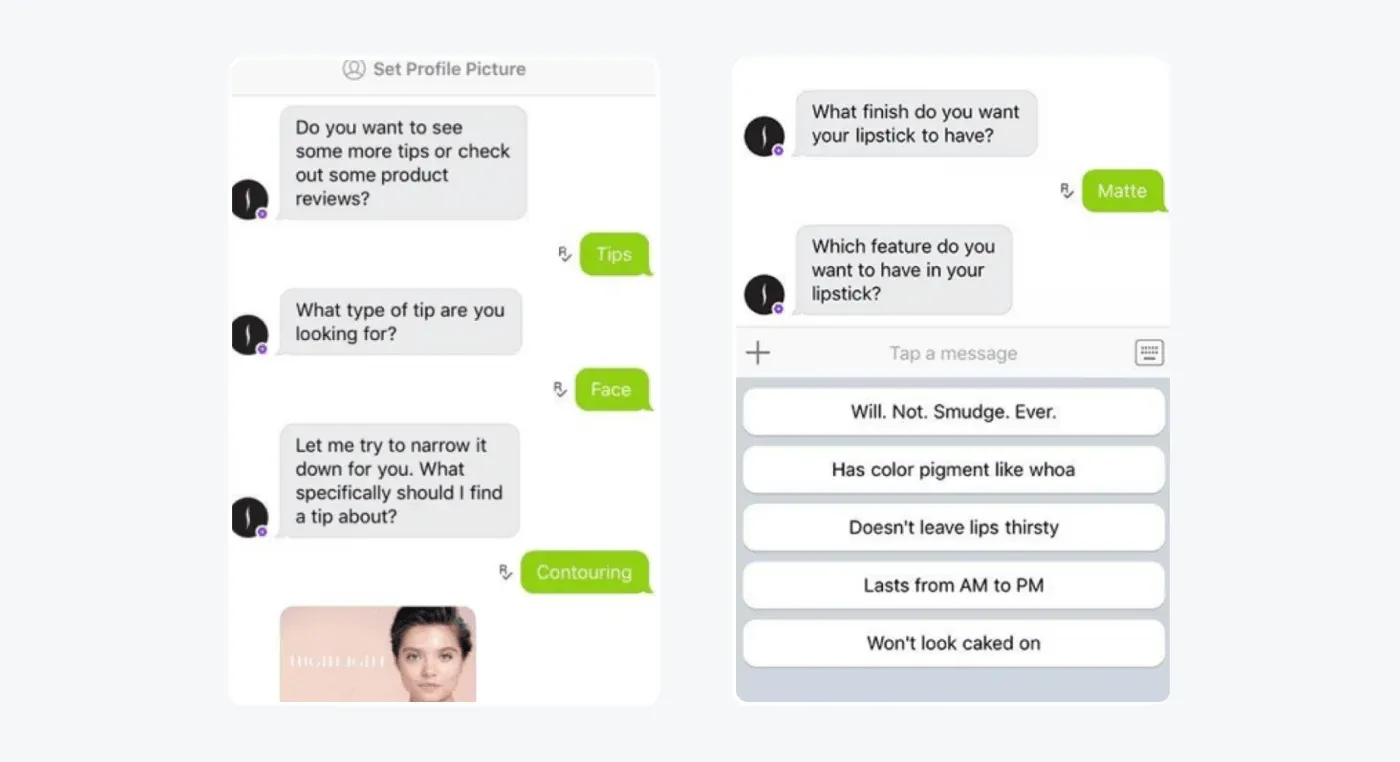
An e-commerce chatbot is an AI-powered virtual assistant designed to simulate human-like conversations with online shoppers. These e-commerce AI chatbots utilize natural language processing (NLP) and machine learning algorithms to effectively understand and respond to customer queries.
AI chatbots can be of different types. And to have a good understanding, let us learn about them in detail.
Rule-based chatbots for e-commerce operate on predefined rules and workflows, providing scripted responses based on keyword matching. While they are more straightforward to implement, their interactions are limited to the defined rules.
AI-powered e-commerce chatbots leverage machine learning algorithms to improve their responses over time. They can analyze customer queries, understand context, and provide more personalized and dynamic interactions.

Hybrid e-commerce chatbots combine the functionalities of rule-based and AI-powered chatbots, offering a balance between predefined responses and adaptive learning. This allows users to have a more versatile and efficient chatbot experience.
In today's fast-paced e-commerce landscape, leveraging e-commerce chatbots is becoming increasingly vital for businesses looking to enhance customer interactions and streamline operations.
Let's explore how incorporating e-commerce chatbot use cases into your online store can empower your business by providing efficient customer support and boosting sales and conversions.
E-commerce chatbots are pivotal in streamlining customer support processes, offering real-time assistance, and simplifying complex procedures.
Customers often seek real-time updates on their orders and shipments. E-commerce chatbots enable seamless order tracking, allowing customers to receive immediate status updates and eliminating any uncertainties related to their purchases.
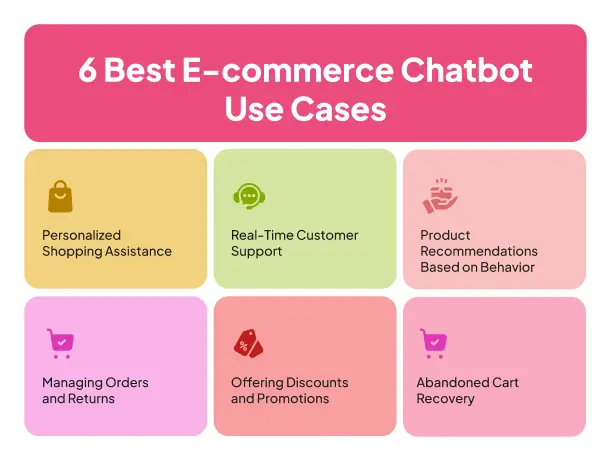
By guiding customers through return and exchange procedures, e-commerce chatbots can simplify these often cumbersome processes.
They provide clear instructions and support, enhancing the overall customer experience and reducing the burden on customer service teams.
Efficient use of e-commerce chatbots can significantly boost sales and conversions, providing personalized recommendations and guiding customers through the purchase journey.
E-commerce chatbots analyze customer preferences and browsing behavior to offer personalized product recommendations.
By understanding customer needs and preferences, chatbots for e-commerce enhance the shopping experience and increase the likelihood of conversion.
Chatbots for ecommerce can suggest complementary or upgraded products, effectively capitalizing on upselling and cross-selling opportunities.
Businesses can increase their average order value and maximize sales by intelligently recommending additional items.
E-commerce AI chatbots are pivotal in guiding customers through checkout, ensuring a seamless and efficient transaction. They can assist with adding items to the cart, apply discounts, and address any concerns during checkout.
Suggested Reading: Boost Your Business: Ecommerce App Builder's Key Feature
Take a look at these real-life ecommerce chatbot use cases showcasing their effectiveness in offering personalized experiences and engaging customers in interactive conversations.
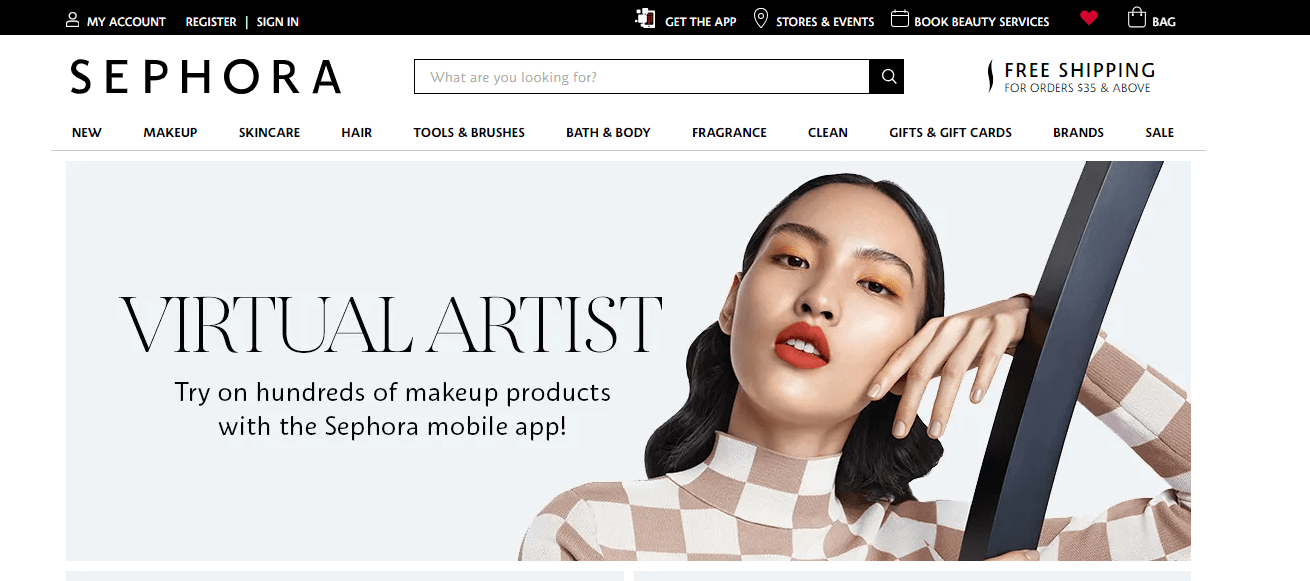
Sephora's e-commerce chatbot uses augmented reality (AR) technology to let customers virtually try makeup products. Before purchasing, users can chat with the bot to find and try different lipstick shades, eyeshadows, and other cosmetics.
JioMart is an Indian convenience store brand. Its WhatsApp e-commerce chatbot helps customers check their order status, track delivery, request returns or exchanges, search for products, and more. The e-commerce chatbot also acts as JioMart's virtual assistant and allows customers to clarify their queries related to any products.
Midland Realty is a Hong Kong-based real estate giant. They devised an innovative solution to facilitate interaction between prospective clients and agents: WhatsApp e-commerce AI chatbots.
This e-commerce chatbot creates a direct communication channel between customers and agents, resulting in faster responses, quality service, and proactive engagement for maximum lead generation.
Kit is a virtual marketing assistant developed by Shopify, an e-commerce platform. Kit helps Shopify merchants with various marketing tasks, such as running Facebook ads, sending thank-you emails to customers, and managing social media posts through simple chat-based interactions.
Erica is an e-commerce chatbot mainly used as a customer virtual assistant.
The chatbot caters to the bank’s customer service requirements, such as providing balance information, sending notifications to customers, providing credit updates, facilitating payments, and helping customers with other simple banking transactions.
As e-commerce continues to evolve, the role of e-commerce chatbots in enhancing customer experiences and driving business growth is becoming increasingly important. In this section, we will explore two notable trends and developments shaping the future of e-commerce chatbots.

One major trend in recent years is the incorporating of e-commerce AI chatbot with popular voice assistants like Google Assistant and Alexa. Businesses are leveraging the power of voice-enabled chatbots to interact with customers seamlessly because of their way of handling customers.
By integrating e-commerce chatbots with these voice assistants, e- commerce platforms can provide a hands-free shopping experience. Customers can browse, order, and receive personalized recommendations using just their voice.
This integration improves customer convenience and opens new channels for businesses to engage with their audience.
For example, a customer can simply say, "Hey, Alexa, order a pair of running shoes from my favorite sports brand."
The e-commerce AI chatbot, combined with voice assistant capabilities, can recognize the customer's preferences, showcase relevant product options, and complete the purchase without manual interaction.
Another significant development in e-commerce chatbots is the advancement of Natural Language Processing (NLP) technology.
NLP enables e-commerce AI chatbots to understand and interpret human language, making conversations between customers and chatbots more natural and human-like.
With improved NLP capabilities, e-commerce chatbots can now recognize nuances in customer queries, understand context, and provide more accurate responses.
This helps create a smoother and more personalized shopping experience, where customers can engage with chatbots as if interacting with a human customer service representative.
As ecommerce chatbots become more proficient in understanding and responding to customer needs, businesses can deliver better customer support, offer tailored product recommendations, and ultimately drive higher customer satisfaction and conversion rates.
In conclusion, in the lively world of online shopping, e-commerce chatbots have emerged as powerful tools for their convenience and prompt service. With the help of e-commerce AI chatbots, businesses can offer more personalized and prompt customer service, streamline operations, and boost sales and conversions.
With their unique features of understanding human conversation tones, fast replies, and the ability to mimic human-like interactions, e-commerce chatbots are like multi-tasking agents with zero complaints.
E-commerce chatbots can do wonders, whether providing 24/7 customer support, assisting buyers in choosing their required items or registering complaints.
With the growing need for e-commerce solutions, chatbots' future is promising. With trends such as integration with voice assistants and advancements in NLP technology, e-commerce chatbots will become even more powerful tools for businesses, enabling them to deliver exceptional customer experiences and drive growth in the e-commerce industry.
Suggested Reading : 10 Innovative Ecommerce Chatbot Use Cases in 2026
An ecommerce chatbot is an AI-powered virtual assistant that communicates with customers in real-time on ecommerce platforms.
It simulates human conversation and can answer questions, provide recommendations, and assist with transactions, enhancing the overall shopping experience.
Ecommerce chatbots use artificial intelligence, natural language processing, and machine learning algorithms to understand and respond to customer queries.
They analyze customer data, provide personalized recommendations, and automate customer interactions, improving efficiency and customer satisfaction.
Yes, ecommerce chatbots are designed to streamline customer support processes.
They can answer frequently asked questions, provide real-time order tracking, simplify return and exchange procedures, and offer personalized product recommendations, improving the overall customer support experience.
Ecommerce chatbots are being utilized across various industries, including retail, fashion, electronics, and hospitality. Companies like Amazon, Sephora, and H&M have successfully implemented chatbots to enhance customer experiences and drive engagement and sales.
Popular examples include Amazon's chatbot for personalized shopping experiences, Sephora's chatbot for makeup recommendations, and H&M's chatbot for interactive engagement on social media.
These chatbots leverage AI and data analysis to provide tailored experiences and increase customer engagement.
Custom Development
7 Apr 2026
Tell us what your business actually runs on today, and we will map what it takes to make it one system.