

Custom Development
Alcohol Delivery Market Share and Trends: Size, Growth, & Business Opportunities
7 Apr 2026
Costco makes billions not by selling more but by charging people to shop.
That single fact turns the usual retail logic upside down, and it works brilliantly.
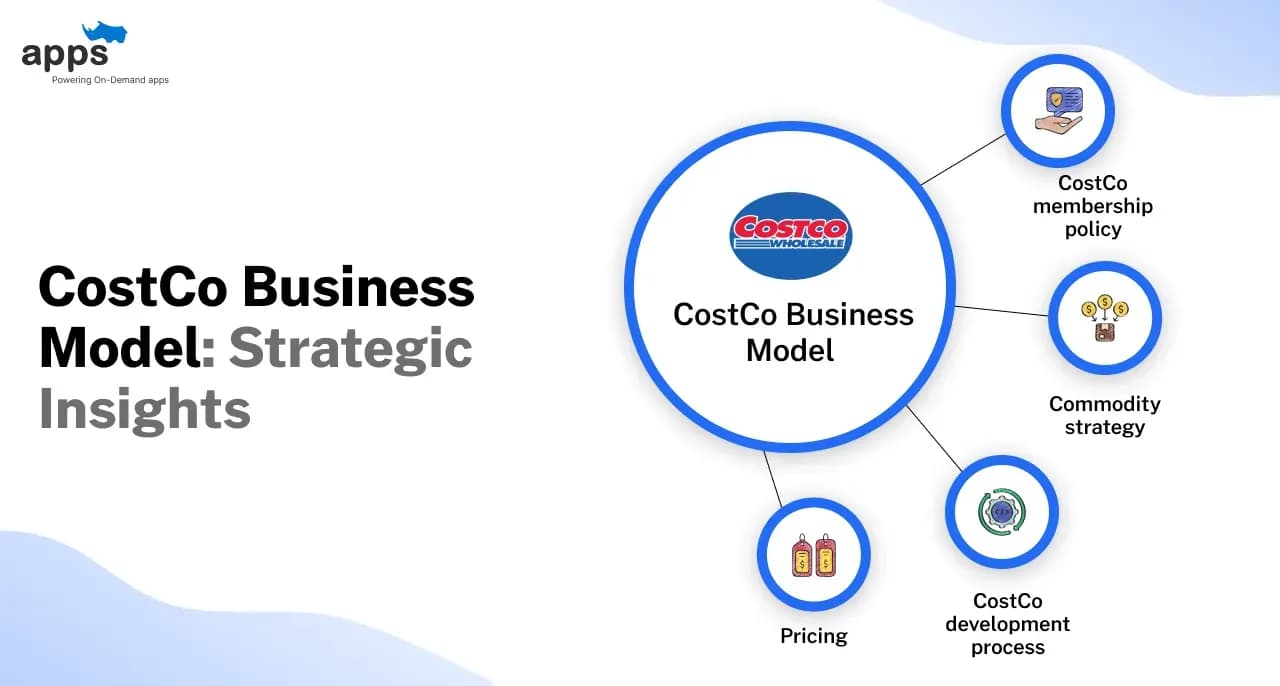
The Costco business model has redefined how consumers perceive value, loyalty, and trust. Instead of relying on high markups, Costco thrives on a membership model, low-margin strategy, and bulk purchasing power that keeps prices low and customers loyal.
This blog dives into what is Costco’s business model, how it operates behind the scenes, and the key strategies that make it one of the world’s most profitable retailers.
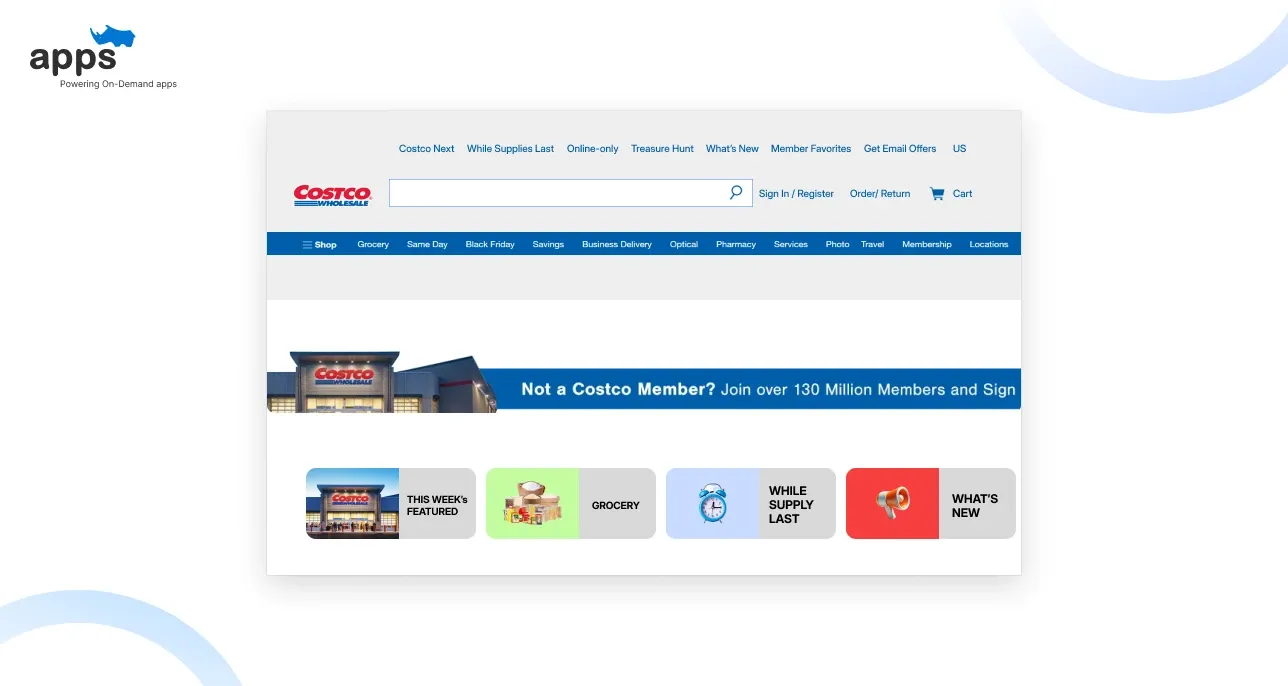
Costco is a membership-based retail giant that sells products in bulk at low prices.
Instead of relying on big markups, it earns mainly from membership fees and efficient operations.
Its stores are called warehouses, which focus only on essentials:
Founded in 1976 as Price Club in California, Costco merged with Costco Wholesale in 1993 and expanded rapidly. Its mission remains clear: to offer quality products at the lowest prices while maintaining strong supplier relationships, as outlined in the Costco Wholesale 2012 mission, business model, and strategy.
With 800+ warehouses across 12 countries, Costco’s warehouse retailing model thrives on bulk sales, low overhead, and consistent pricing.
The no-frills store design keeps operations lean and passes savings directly to members.
Costco’s wholesale strategy combines scale and customer loyalty. By buying in huge volumes, it secures better supplier rates and sells in bulk to members worldwide, delivering consistent value across every location.
Costco’s success comes from keeping things simple, fewer frills, more value.
Next, we’ll uncover the Costco Business Model that powers this global success.
The Costco Business Model is built on delivering low prices through bulk scale, creating loyalty through membership, and running ultra-efficient operations.
Each central pillar supports the others. The result: a retail giant that remains calm, even when competitors heat up.
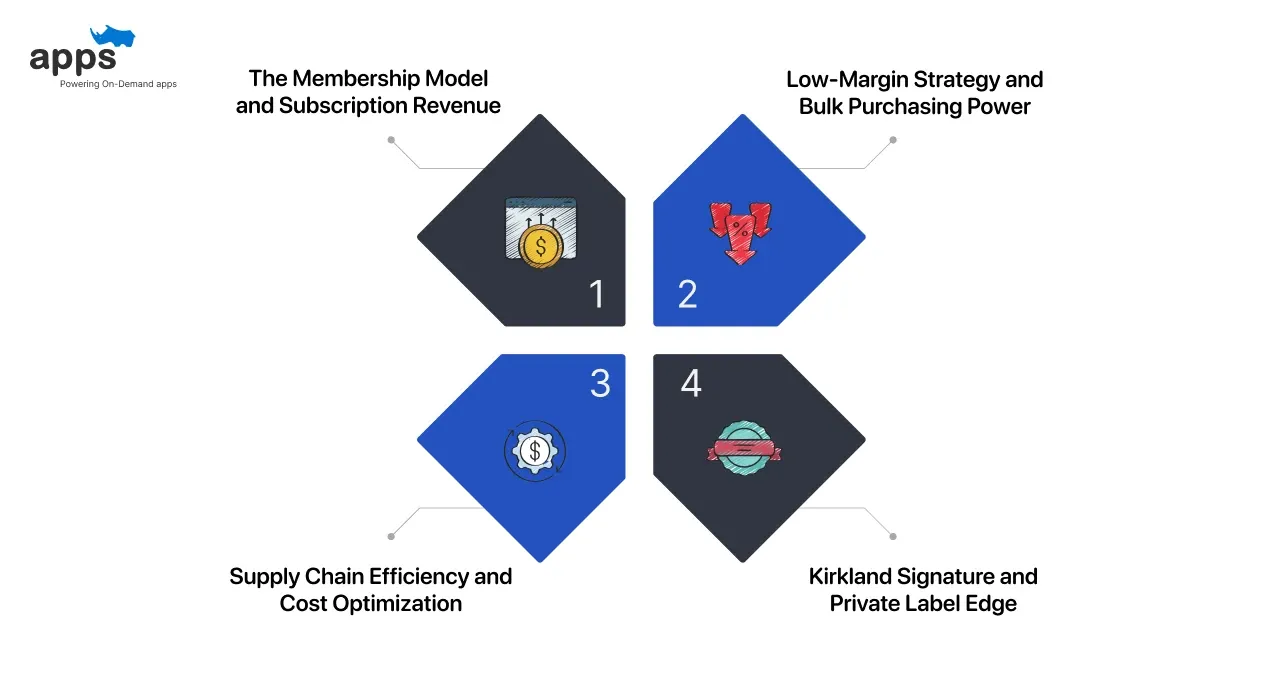
Costco earns differently than most retailers through its membership model.
You must pay a yearly fee to shop, and that fee becomes part of the company’s predictable subscription revenue.
This model answers the question: how does Costco make money? Not through significant markups, but by combining subscription revenue with high-volume sales.
Costco takes the opposite stance of high-margin retail. Its low-margin strategy focuses on selling more for less.
By combining bulk buying with low markups, the wholesale strategy becomes a win for both Costco and its members: low cost for you, efficient volume for the company.
One key strength of the costco business model is its private-label brand: Kirkland Signature.
Because members associate Kirkland with value and quality, Costco doesn’t need heavy advertising. The brand becomes a powerful layer in the membership-and-value loop.
Costco’s operations run lean. Supply chain matters. Real amounts. The company emphasizes supply chain efficiency to support its low-cost offers and speed.
These practices make Costco’s costco pricing strategy work: consistent value, fewer surprises, and operations built to scale.
This walk-through of the central pillars of the Costco Business Model shows why it works so reliably.
Next up, we’ll map out the business structure using the Costco Business Model Canvas and visually see how all these pieces fit together.
Costco’s income flow is simple yet effective. The Costco business model combines recurring membership revenue, high-volume sales, and strict cost control to drive loyalty and long-term profitability.
By understanding these revenue streams and cost levers, you’ll see how Costco makes money and why it has built such a resilient business.
A key part of the Costco business model is its membership model, in which shoppers pay upfront for access.
Because membership fees are predictable and margin-rich, Costco can sell goods at slim margins while still turning a solid profit.
Most of Costco’s revenue comes from bulk product sales across categories such as food, electronics, apparel, and household goods.
This mix of large-scale retail sales and membership income keeps the revenue engine humming.
Beyond bulk goods and memberships, Costco adds value and revenue through ancillary services. These include:
While each of these doesn’t drive the bulk of revenue on its own, together they enhance the customer experience, increase store visits, and boost overall spend per member.
Costco’s competitive edge lies in its tight cost structure, and disciplined execution is a key part of its Costco pricing strategy and broader Costco business strategy.
All of this means Costco can offer savings to members while maintaining healthy business margins.
Costco’s revenue model and cost control form the backbone of its unique retail proposition.
In the next section, we’ll explore the Costco business model canvas and visually map how all these elements fit together into one cohesive system.
Here’s how the pieces of the Costco business model fit together in a clear and structured way. This canvas shows how value is created, delivered, and captured across the business.
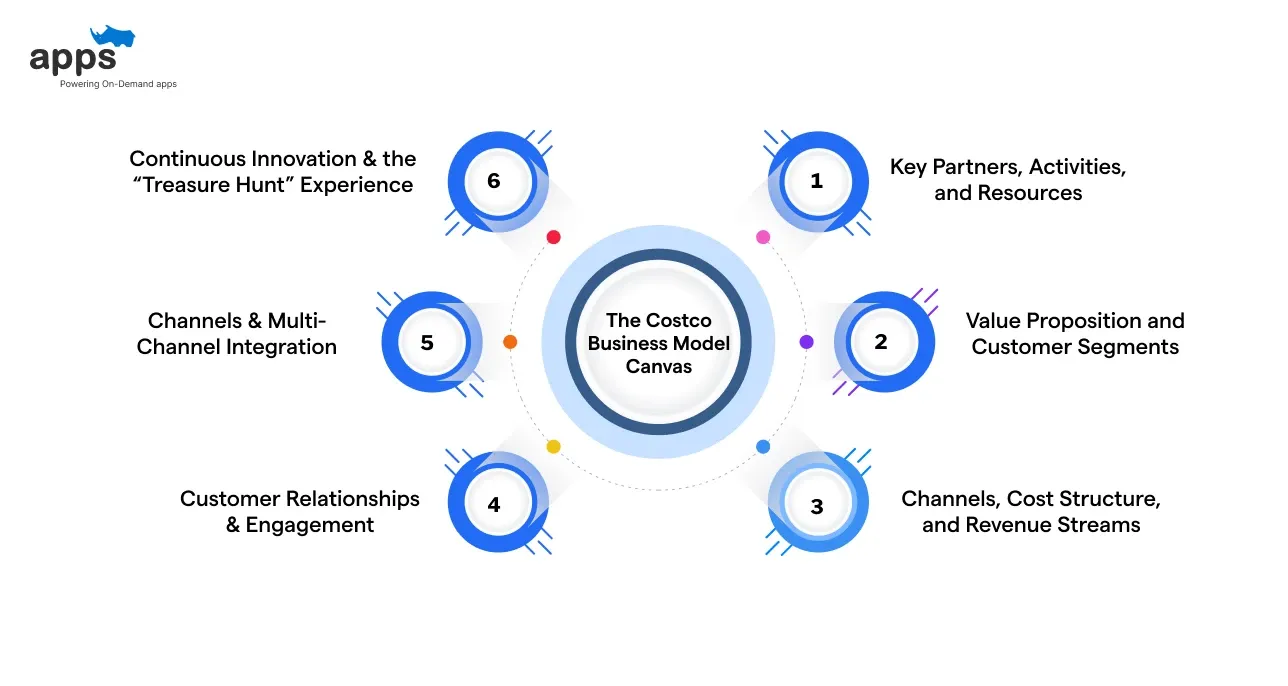
Costco’s success begins with its strategic partnerships. The company collaborates closely with manufacturers and suppliers many behind the Kirkland Signature brand to secure exclusive products and bulk purchasing advantages.
Beyond suppliers, Costco also partners with financial institutions (like Visa for co-branded credit cards), logistics providers, and technology firms to enhance digital operations and data analytics.
Core activities include warehouse retailing, large-scale procurement, supply chain efficiency, and membership management.
Its essential resources are vast warehouse locations, advanced logistics systems, and a loyal, recurring membership base that ensures steady subscription revenue.
Costco’s value lies in its low-margin strategy offering premium goods at unbeatable prices.
Its private label, Kirkland Signature, reinforces trust through quality and affordability, giving customers more for less.
Primary customer segments include value-driven households, small businesses, and B2B clients through the Costco Business Center.
Globally, Costco tailors product variety and pricing for local markets while ensuring its wholesale strategy remains consistent across regions.
Channels: Physical warehouses remain Costco’s foundation, complemented by e-commerce platforms, mobile apps, and online membership services.
Cost Structure: Costco minimizes operational costs through lean inventory, limited SKUs, direct sourcing, and minimal advertising—driving superior supply chain efficiency.
Revenue Streams:
The CostCo Business Model emphasizes trust through long-term relationships. Its no-questions-asked return policy, membership renewals, and in-store experiences like product samplingenhance customer loyalty.
Costco also engages B2B buyers with tailored pricing and support through its Business Centers, aligning with its costco business strategy of inclusivity across market segments.
The company leverages costco insights resources and customer analytics to refine offerings, manage demand, and ensure consistency across regions.
While warehouse retailing remains core, Costco is rapidly scaling its digital presence.
The brand’s integration of e-commerce, pickup & delivery, and mobile membership scanning ensures convenience for modern consumers.
Through this omnichannel strategy, Costco blends in-store experiences with online accessibility balancing tradition with technology.
One of the most unique aspects of costcos business model is its “treasure hunt” approach offering limited-time deals and rotating products to encourage repeat visits.
This retail psychology drives excitement, customer loyalty, and frequent footfall, differentiating Costco from rivals like the costco vs walmart business model comparison shows.
Additionally, ongoing innovation in logistics, AI-driven forecasting, and ethical sourcing strengthens the costco ethical business model and aligns with the costco wholesale in 2012 mission business model and strategy to deliver value, efficiency, and sustainability.
This updated canvas section covers both the major blocks of Costco’s model and deeper pointers (such as the treasure-hunt inventory strategy, tech partnerships, and the B2B channel).
Next, we’ll move into how Costco stacks up against its rivals in the Costco vs Walmart business model section.
Costco and Walmart both dominate global retail, but their paths to success couldn’t be more different.
Here’s a concise comparison of their core business strategies based on 2024 data from Forbes, Business Insider, and Statista.
| Feature | Costco | Walmart |
| Business Model | Membership-based warehouse retailing | Open-access retail model |
| Access Type | Paid membership required | Free access for all shoppers |
| Main Revenue Source | Membership fees & bulk product sales | Retail sales volume across broad categories |
| Pricing Strategy | Low-margin strategy with bulk purchasing | Everyday Low Pricing (EDLP) for consistent affordability |
| Average SKU Count | ~4,000 (limited, high-volume items) | 100,000+ (broad product range) |
| Private Label | Kirkland Signature – quality-focused | Great Value, Equate – price-focused |
| Customer Loyalty | Driven by ~90% membership renewals | Driven by convenience and price |
| Marketing Approach | Minimal advertising; word-of-mouth | Multi-channel marketing and online ads |
Costco wins on loyalty and trust, Walmart on scale and reach, but both redefine value in their own way.
Next, we’ll explore how Costco’s ethical practices and sustainability commitments shape its Costco Ethical Business Model.
The Costco business model emphasizes ethical sourcing, fair labour, sustainability, and transparency.
These efforts build long-term trust, strengthen customer loyalty, and ensure the brand grows responsibly.
Costco follows a strict Code of Ethics and Supplier Code of Conduct to protect human rights, labour standards, and environmental safety.
According to marketing-scoop research, employees in the U.S. earn an average of $24 per hour, with benefits for full- and part-time workers.
Panmore reports that in FY2024, Costco contributed over $84 million to community charities and relief programs.
Its supplier teams regularly audit partners to ensure safe conditions and fair practices.
Sustainability aligns naturally with Costco’s bulk purchasing model. In 2024, packaging changes in Kirkland Signature products eliminated 4 million pounds of plastic and saved nearly $8 million.
The STAR program focuses on cutting energy, water, and waste, reducing landfill impact across warehouses.
By selling in larger quantities, Costco minimizes packaging waste and shipment frequency, lowering its carbon footprint.
Costco’s mission, “For Costco to thrive, the world must thrive,” guides its ethical strategy.
The company targets a 39% reduction in Scope 1 & 2 emissions by 2030 and publishes regular ESG updates. Ethical sourcing and sustainability drive customer confidence, proving that profit and purpose can coexist.
These commitments position Costco as a trusted and responsible global retailer.
Costco enforces transparency across its global supply chain. Suppliers must disclose factory details, follow strict human rights standards, and allow third-party audits.
Products like coffee, cocoa, and seafood are ethically sourced under traceable, fair-trade programs.
This ensures Costco’s global operations remain compliant, fair, and environmentally responsible.
Costco invests heavily in renewable operations. Solar energy powers many warehouses, and the company continues shifting to electric delivery fleets.
According to Tracenable data, in 2023, Costco reported 2.88 million tCO₂e in direct emissions, aiming for significant reductions by 2030.
These steps demonstrate measurable progress toward a cleaner, more sustainable retail network.
Ethical leadership anchors Costco’s growth. Its governance committees oversee compliance, sustainability, and employee welfare.
Executives maintain transparent pay structures and open reporting systems.
This leadership culture ensures Costco’s expansion remains fair, honest, and people-focused.
Costco proves that responsibility and profitability can go hand in hand, making ethics a strength rather than an afterthought.
Next, we’ll explore how this model scales globally while maintaining its core values.
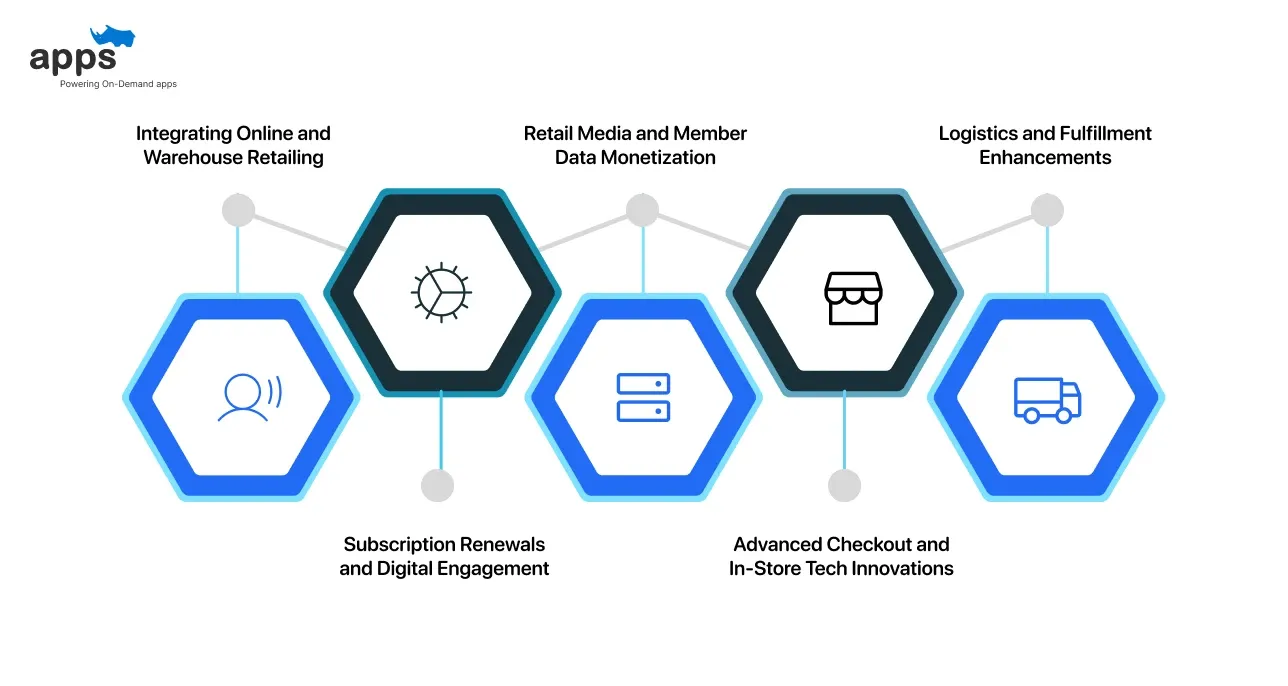
The Costco business model now merges warehouse retailing with online convenience, data-driven engagement, and modern logistics, ensuring that technology enhances, not replaces, its member-first philosophy.
Costco’s online and physical operations work seamlessly together. Digital Commerce reports claims that Online sales grew 18.9% year-over-year in 2024, powered by expanded e-commerce listings, same-day delivery, and in-store pickup.
Members can now order bulky or out-of-stock items online and collect them from nearby warehouses. This hybrid setup helps Costco maintain its low-cost advantage while improving accessibility.
Digital tools are reshaping Costco’s membership model and subscription revenue. Through the mobile app, users renew memberships, upgrade tiers, and access digital receipts.
Executive memberships now account for 46.5% of all members and drive over 73.5% of global sales, according to Infotechlead. This digital shift keeps engagement high and simplifies renewals, building lasting customer loyalty.
Costco is quietly expanding into retail media, leveraging member insights for brand promotions and product placements. By analyzing purchase behavior, Costco offers partners targeted marketing opportunities without breaching trust.
This data-driven approach adds a new revenue stream while improving customer relevance.
Costco is testing digital checkout experiences, such as “Scan & Pay” and self-service kiosks. These upgrades reduce wait times and enhance convenience without increasing overhead.
As Business Insider reports, in 2025, Costco began piloting mobile shopping and digital receipts in select U.S. warehouses, modernizing the warehouse retailing experience.
Behind the scenes, Costco has optimized fulfillment for heavy and bulk items. Advanced route planning and partnerships with last-mile carriers have reduced delivery times by up to 25%.
These logistics upgrades allow Costco to scale online orders efficiently while maintaining cost discipline.
In 2024, Costco’s e-commerce revenue hit $19.6 billion, about 7% of total sales. The next phase focuses on omnichannel expansion, personalized recommendations, predictive restocking, and warehouse-to-home delivery.
By blending technology with its wholesale roots, Costco’s digital strategy strengthens its position as a trusted, modern retailer.
Costco’s digital transformation proves innovation doesn’t have to disrupt what already works; it can enhance it.
The Costco Business Model has proven remarkably adaptable worldwide. Built on a strong membership model, bulk purchasing, and a low-margin strategy, Costco continues to scale across global markets while maintaining its promise of affordability and value.
Its approach combines operational efficiency, cultural awareness, and long-term customer loyalty, reinforcing why costcos business model stands as one of the most resilient in modern retail.
Costco adds 25–30 new warehouses each year, with nearly half located outside the U.S.
According to Nasdaq reports, by 2025, the company is expected to reach 914 global warehouse locations, continuing its steady expansion strategy rooted in the Costco Wholesale mission business model.
This disciplined growth supports the subscription revenue model while sustaining brand reliability worldwide.
The CostCo Business Model Canvas emphasizes data-driven market selection. Costco targets regions with high household income, strong car ownership, and proven interest in membership-based shopping.
SlideShare data reveals that by focusing on these demographics, Costco ensures its warehouse retailing and wholesale strategy resonates locally while driving profitability and member engagement.
In urban markets like China and Japan, Costco reduces its SKU count to 2,000–3,000 items while featuring more locally relevant private label and Kirkland Signature products.
This localization strengthens its customer loyalty while maintaining the efficiency of bulk purchasing and the trusted warehouse model.
From redesigned layouts to localized Kirkland Signature assortments, markets like Spain, Japan, and Canada receive tailored experiences that reflect regional preferences.
Such adaptability ensures that Costco’s business model remains relevant while delivering the same value proposition globally.
Supply chain efficiency enables Costco to maintain stable pricing and its low-margin strategy worldwide.
For example, regional sourcing in Asia-Pacific reduced costs by up to 40% on select Kirkland Signature products.
This efficiency aligns perfectly with the Costco pricing strategy, keeping prices uniform and competitive across borders.
Despite global success, Costco faces foreign-exchange risks, tariff challenges, and land costs in emerging markets.
However, its large-scale procurement, streamlined logistics, and robust wholesale strategy help offset these pressures.
This balance allows Costco to protect margins without sacrificing affordability, showcasing the strength of the costco ethical business model.
As Costco expands globally, the CostCo Business Model faces both hurdles and growth opportunities shaped by regional dynamics
Challenges
Opportunities
Through these challenges and opportunities, the CostCo Business Model continues to evolve, balancing global efficiency with local relevance.
It merges global reach with local relevance showing exactly how does costco make money while sustaining its promise of value, quality, and trust.
The Costco Business Model is a blueprint for sustainable growth built on value, trust, and efficiency. Here are seven key lessons modern businesses can apply to build loyal customers and long-term profitability.
Recurring income from a membership model ensures stability and strengthens customer loyalty through exclusivity and engagement.
Adopting a low-margin strategy builds trust, offering consistent quality at fair prices, drives repeat purchases, and word-of-mouth growth.
Direct sourcing and supply chain efficiency reduce costs and improve delivery speed, creating a lasting advantage in wholesale strategy.
Fewer SKUs and bulk purchasing allow operational simplicity and pricing control, key pillars of the Costco business model canvas.
The costco ethical business model proves that responsible sourcing and fair labor practices enhance reputation and loyalty.
Brands like Kirkland Signature show that private label products can build trust and deliver high margins while keeping prices low.
Combining warehouse retail with online sales and subscription revenue strengthens omnichannel engagement and customer retention.
Each of these principles makes the Costco Business Model a masterclass in balancing efficiency, value, and sustainability.
The brilliance of the Costco Business Model lies in its simplicity: deliver value, earn trust, and scale through efficiency. Costco didn’t just master retail; it reinvented it through its membership model, low-margin strategy, and relentless focus on customer loyalty.
Every decision from bulk purchasing to supply chain efficiency reflects a system built for long-term success, not short-term wins.
That same principle drives growth in the digital age. Businesses that optimize operations and create seamless ecosystems thrive, just as Costco does.
At AppsRhino, we bring that same discipline to digital transformation. Whether you’re building a warehouse management system, on-demand platform, or custom retail solution, we design apps that streamline operations and maximize ROI.
Custom Development
7 Apr 2026
Tell us what your business actually runs on today, and we will map what it takes to make it one system.