

Custom Development
Alcohol Delivery Market Share and Trends: Size, Growth, & Business Opportunities
7 Apr 2026
A strange pattern appears in startup post-mortems: companies with great products fail, and companies with imperfect products succeed. The difference isn’t the idea, it’s how fast and affordably they build the first version. And nothing impacts that more than the developers they hire.
Many founders assume they need big budgets, large teams, or senior engineers from day one. But data from global accelerators shows the opposite. Startups that begin with lean teams and controlled development costs are 3× more likely to reach product–market fit than those that overspend early.
This blog shows how to hire developers for startup projects effectively, build your MVP team without burning capital, and develop your first product without high upfront costs, whether you want to hire developers for startups, local app development or explore budget-friendly offshore options.
Let’s break down how to build more while spending less.
Hiring developers is one of the highest-impact decisions a founder makes. Every choice affects your speed, budget, and product quality. That’s why the process to hire developers for startup teams must be structured and cover every step from scoping to onboarding.
Here’s a clear, practical, startup-friendly guide that ensures you avoid hiring mistakes and build the right MVP team from the start.
Start by outlining your core problem, must-have features, and the exact outcome your MVP should deliver. This step determines whether you need full-stack developers, mobile developers, or specialists in AI, DevOps, or backend systems. Without a clear scope, founders overspend or hire mismatched talent.
Decide whether your project needs: frontend, backend, ReactJS developers, full-stack, mobile, AI/ML, DevOps, cloud, or UI/UX. If you want to hire developers for a startup app, full-stack and mobile are usually the fastest combination for launch.
Pick a model based on your budget and timeline:
This is a significant decision in startup hiring.
Startups' Founders who hire developers for startup India projects usually save 40–60% while getting strong engineering skills. Your budget should match your tech needs, not just the cheapest option.
Your JD should include:
A clear JD filters out unfit candidates instantly.
Use a mix of: LinkedIn, GitHub, niche developer platforms, remote hiring platforms, offshore vendors, and startup-focused agencies like AppsRhino.
This widens your pool of startup developers.
Check GitHub contributions, previous MVPs, UI quality, real shipped apps, and code cleanliness. Strong MVP developers always have real, working samples.
Shortlist developers with:
Avoid theoretical interviews. Test real skills.
Assign a 5–8 hour mini-project that matches your real work. This is the single most accurate filter in startup software development; how someone builds is more important than what they claim. Check for communication, ownership, learning speed, time-zone responsiveness, and a startup mindset. Startups need people who move fast with minimal supervision.
Especially when you hire remote developers, ensure at least 3–4 hours of overlap and smooth communication habits.
Protect your product. Make sure contracts clearly define deliverables, timelines, ownership, and confidentiality.
Share:
A smooth onboarding boosts productivity from day one.
Use tools like Jira, Trello, GitHub, Slack, or Notion to manage deliverables and keep your startup engineering team aligned.
With the proper steps, even budget-conscious founders can hire strong talent and build faster.
Next, let’s explore the challenges startups face in hiring and how to address them effectively.
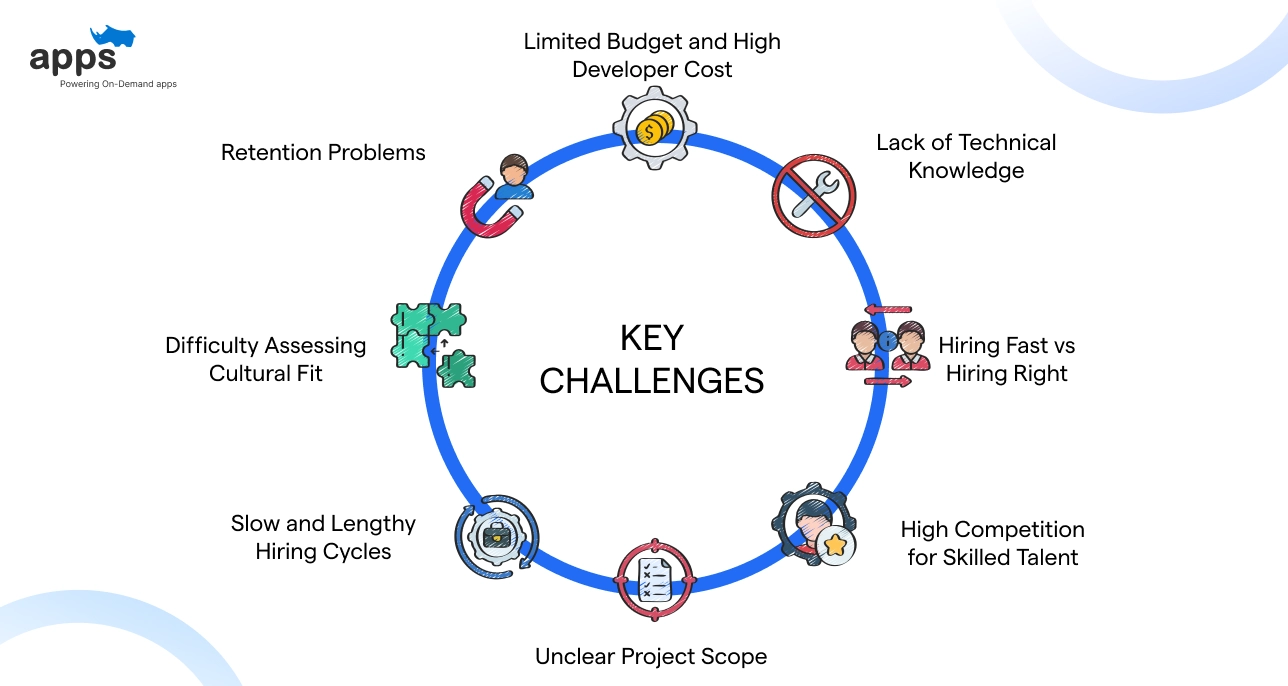
Hiring developers is one of the toughest early decisions for any founder. Startups need speed, quality, and affordability, but balancing all three is difficult.
Below are the most common and high-impact challenges founders face in startup hiring, based on insights from leading competitor blogs.
Startups operate with strict budgets, while skilled startup developers demand substantial salaries, stability, and benefits.
Since enterprises can easily outbid them, founders often struggle to attract experienced full-stack developers for startups or niche experts such as AI, DevOps, or cloud engineers. This gap usually pushes startups toward cheaper, lower-quality hires, leading to more rework later.
Many founders lack engineering expertise, making it hard to validate skills, architecture decisions, or code quality. This leads to hiring developers who appear skilled in interviews but cannot build scalable systems.
Startups feel pressure to release quickly, leading founders to rush hiring without screening deeply. This results in developers who cannot deliver, inflate timelines, or fail to meet the required quality.
A single rushed hire can slow down the entire software development cycle of a startup.
Startups compete with global companies, unicorns, and offshore firms for the same pool of developers. Top engineers prefer stability or high-paying enterprise roles, leaving early startups with fewer choices.
If the product vision is unclear, developers struggle to estimate timelines, costs, or the tech stack.
Startups frequently hire before finalizing features, user journeys, or priorities.
This causes confusion, repeated interviews, mismatched candidates, and late project delivery.
Competitor blogs emphasize that hiring a good engineer often takes 6–12 weeks, which early startups cannot afford. Screening, coding tests, interviews, and negotiations take time, slowing product momentum.
This delay can result in missed market opportunities or delayed MVP releases.
Startups need adaptive, proactive developers who can handle chaos and not just coders.
However, cultural fit is difficult to judge in short interviews. Competing blogs highlight that poor cultural alignment leads to miscommunication, slower output, and low ownership.
Even after hiring, developers may leave for higher-paying offers from global companies.
High turnover means startups must restart hiring cycles, lose knowledge, and waste onboarding time. Retention is a significant challenge highlighted across competitor articles.
Founders often don’t know whether they need a freelancer, an in-house engineer, an offshore developer, or a complete MVP team. Choosing the wrong model increases costs, reduces accountability, and slows development, especially in the early stages.
To mitigate this risk, founders should learn how to hire dedicated developers with AppsRhino, as the dedicated team model offers high accountability and flexible scaling.
These challenges show why hiring developers is one of the most strategic decisions for any startup.
Next, let’s explore the prominent benefits startups gain when they hire developers the right way.
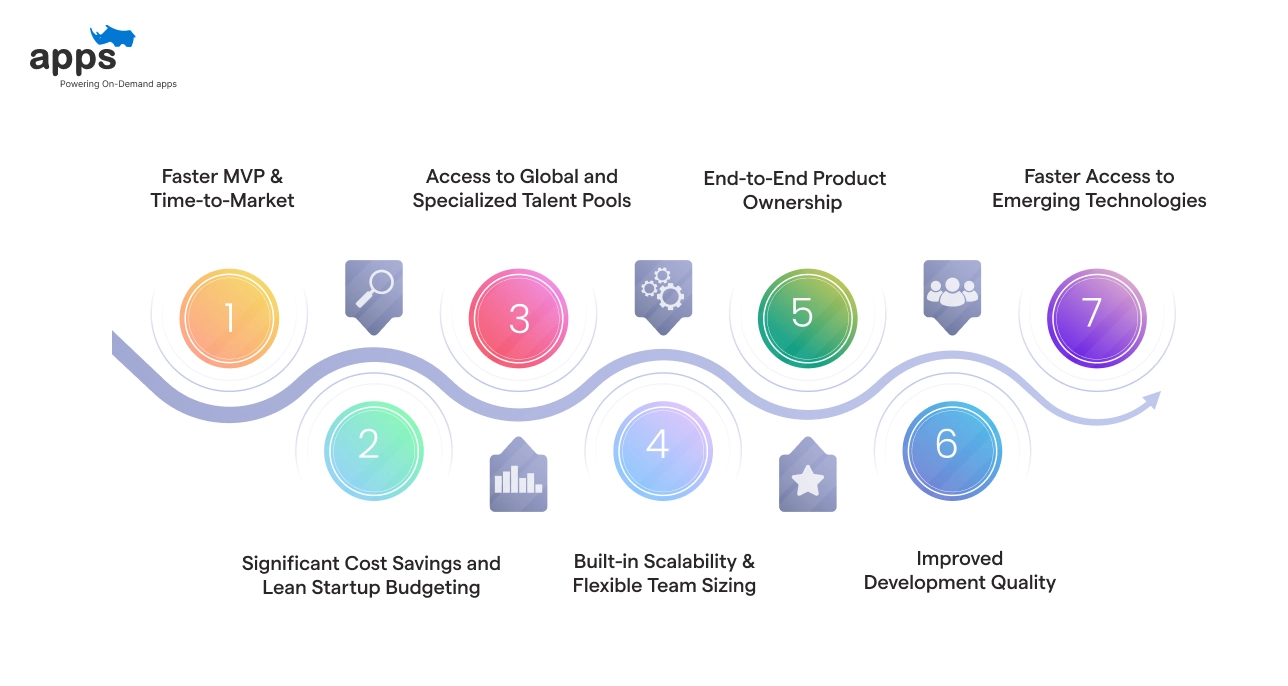
Choosing the right team is no longer a nice-to-have; it’s a survival tactic. With nearly 90% of startups failing globally, the quality of your development team often determines whether you succeed or fade away.
Here’s how hiring skilled developers, whether onsite or outsourced, can drastically boost your chances.
Outsourcing or hiring experienced startup developers enables startups to launch faster. Global trends show hybrid in-house/offshore teams deliver MVPs up to 7 weeks faster than entirely in-house teams.
Faster launches let you test ideas early, gather user feedback, and iterate quickly, reducing time wasted on ideas that won’t work.
Hiring full-time developers comes with high overhead: salaries, benefits, infrastructure, and training. Outsourcing or remote hiring can cut those costs by 15%–70% compared to in-house setups.
A startup that outsources can reallocate savings toward marketing, growth, or product improvements, rather than just payroll.
Startups rarely find all the required expertise locally. Outsourcing or hiring remote teams unlocks access to top-tier developers across cloud, mobile, AI/ML, DevOps, and more, according to The Enter Prise. This access lets you build complex, scalable products without compromising quality, even with a lean “startup hiring” budget.
For example, if your product is mobile-focused, learning how to hire AppsRhino's Android developers allows you to tap into specialized mobile expertise instantly.
Outsourced or remote teams let you scale up or down based on demand. No extra office space. No long-term salary commitments. As your user base grows, so does your startup engineering team. Outsourcing allows rapid ramp-up with minimal fixed costs, perfect for uncertain early-stage growth.
Good developers handle more than coding; in fact, they design, build, test, deploy, secure, and maintain. A reputable startup MVP agency or dedicated offshore team offers full-cycle development.
In 2025, many outsourcing firms guarantee 24/7 support, maintenance, and post-launch updates as part of their packages, according to Wezom reports.
This end-to-end ownership reduces your burden and ensures long-term product quality.
Startups often rush without proper engineering practices. Skilled developers bring proven workflows: code reviews, version control, agile cycles, automated testing, and architecture planning.
Academic studies by Cornell University show that adopting agile and proper software factory approaches improves code quality, maintainability, and long-term stability.
Tech evolves rapidly: AI, cloud, microservices, real-time data. Hiring or outsourcing developers with exposure to these technologies gives startups a competitive edge. Devico reports claims that Outsourcing firms achieve up to 50% faster adoption of new tech stacks than internal teams.
The right mix of talent, flexibility, cost control, and technical discipline can turn risky ideas into scalable products.
Next up, we’ll jump to the next section to understand he need to hire developers for startups.
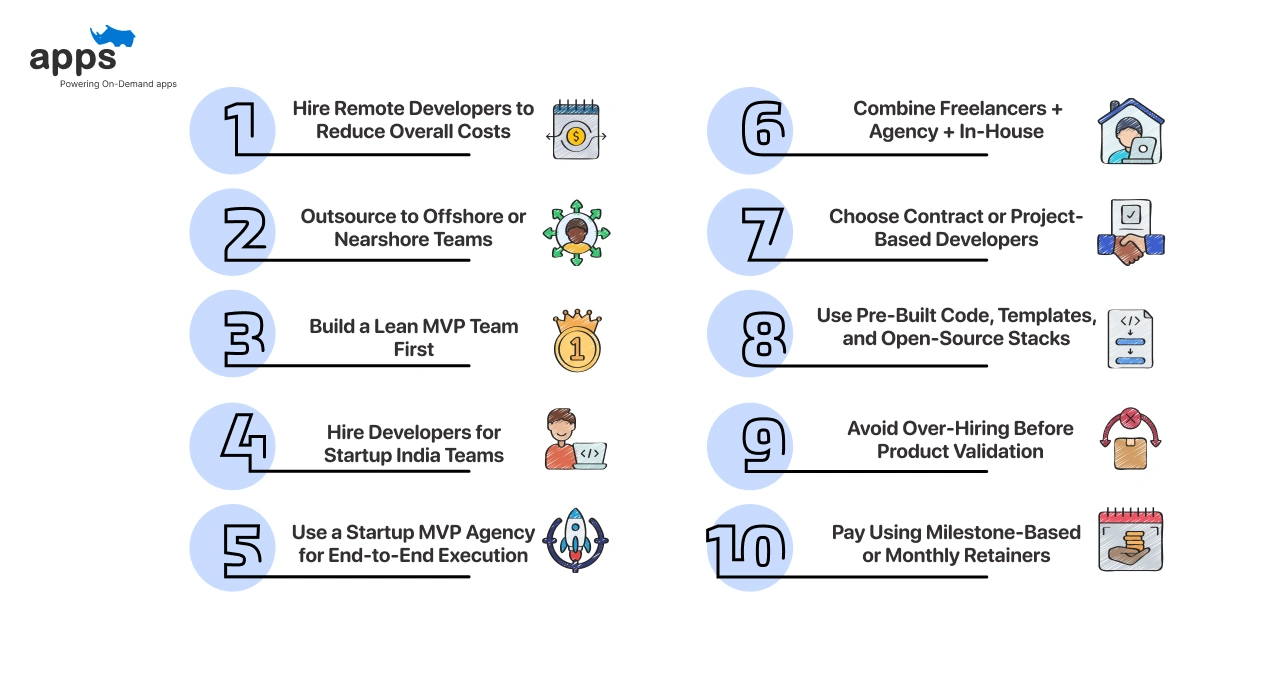
This section walks through the most practical, founder-friendly, and cost-effective ways to hire developers for startup projects while staying lean. Each method is based on proven startup hiring patterns and insights from top industry guides.
Remote developers eliminate office expenses and allow you to tap into strong global talent.
This model gives access to affordable app development and wider expertise at 30–60 percent lower rates than local hiring.
Countries like India, Ukraine, Brazil, and Vietnam offer expert MVP developers at a fraction of Western pricing. This method is ideal for early-stage founders who need predictable costs and agile delivery.
Instead of hiring large teams early, begin with:
This is one of the most recommended approaches across competitor blogs because it reduces burn and accelerates testing.
India remains a top choice for founders who want skilled engineers and predictable pricing.
Indian developers offer strong communication, fast turnaround times, and deep experience in the startup ecosystem.
An MVP team helps founders avoid the cost of hiring multiple specialists. You get product strategy, design, development, QA, and maintenance under one predictable cost.
Hybrid hiring reduces dependency on any single model. You can keep core roles in-house but outsource non-core tasks such as QA, DevOps, or UI.
Contract developers let startups pay only for active development cycles instead of full salaries.
This model keeps fixed costs low while giving access to high-end talent.
Using open-source stacks such as React, Node.js, Flutter, and Django cuts development time by up to 40 percent.
Less coding = lower development cost.
Many early founders make the mistake of hiring too many engineers too early. Hiring gradually keeps your startup's hiring lean and efficient.
Milestone-based payments ensure accountability, faster delivery, and more transparent budgeting. Smart hiring is all about choosing models that reduce financial pressure while maximizing output.
Next, let’s break down global cost comparisons so you know what pricing to expect.
Hiring developers for a startup becomes far more predictable when you understand global pricing patterns. Rates differ widely across regions, depending on skill level, tech stack, market demand, and availability of startup-ready talent.
Whether you plan to hire developers for startup projects locally or offshore, comparing hourly, monthly, freelance, and project-based models helps you make smarter budget decisions.
Countries like India, Vietnam, and the Philippines offer the most affordable rates, while the USA, UK, and Western Europe are the most expensive. Regions such as Eastern Europe and Latin America provide a solid middle ground, with high-skilled talent at moderate cost.
Here’s a clear, updated 2025 comparison to help you plan efficiently.
Region / Country | Hourly Rate (Avg.) | Monthly Rate | Freelancer Rate | Project-Based Cost (MVP) | Best For |
| India | $18–$40/hr | $2,800–$6,000 | $15–$35/hr | $8,000–$25,000 | Budget-friendly MVPs, scaling teams |
| Eastern Europe (Ukraine, Poland, Romania) | $35–$70/hr | $6,000–$12,000 | $30–$55/hr | $20,000–$45,000 | Complex apps, high-quality engineering |
| Latin America (Brazil, Mexico, Argentina) | $30–$60/hr | $5,000–$10,500 | $25–$50/hr | $15,000–$35,000 | Nearshore US startups, agile teams |
| Southeast Asia (Vietnam, Philippines, Indonesia) | $20–$45/hr | $3,000–$6,500 | $18–$35/hr | $10,000–$30,000 | Affordable teams, mobile-first products |
| USA & Canada | $75–$150/hr | $12,500–$22,000 | $60–$120/hr | $40,000–$120,000 | Enterprise-grade builds, local teams |
| Western Europe (UK, Germany, France) | $60–$120/hr | $10,000–$20,000 | $50–$100/hr | $35,000–$100,000 | Fintech, compliance-heavy products |
| MENA Region | $25–$55/hr | $3,800–$8,000 | $20–$45/hr | $12,000–$35,000 | Hybrid cost-quality, regional scaling |
Hiring the right developers is one of the biggest challenges for early-stage founders, especially when budgets are tight and product timelines are short.
This is where AppsRhino makes a meaningful difference. Instead of forcing startups to choose between affordability and quality, the platform helps you hire developers for startup needs with a balanced, predictable, and flexible model.
Whether you're building your first MVP or scaling your product, AppsRhino gives you access to vetted startup developers, global talent, and budget-friendly engagement models that reduce financial pressure without slowing down product development.
AppsRhino provides a curated pool of developers skilled in startup product development, including MVP developers, full-stack talent, and mobile engineers. This ensures you hire people who understand speed, iteration, and lean execution.
You can hire developers for startups as part-time, full-time, hourly, contract-based, or bring in a dedicated development team, whatever suits your budget. This flexibility helps founders avoid overstaffing or long-term salary commitments.
Instead of paying Silicon Valley pricing, AppsRhino lets you hire remote developers for startups from cost-efficient regions like India and Eastern Europe, reducing development cost by 40 to 60 percent.
AppsRhino handles sourcing, screening, interviews, and onboarding. Founders save weeks of hiring time and avoid spending thousands on recruitment tools or agencies.
From mobile apps to SaaS platforms, AI, cloud, and backend systems, the talent pool includes engineers with hands-on startup experience, making it ideal for lean startup development.
You get access to project managers, QA engineers, and design teams when needed, support that most early-stage founders can’t afford in-house.
You pay only for the developers and the duration you choose: no infrastructure or admin costs, no surprise billing.
Hiring the right talent can shape your entire product journey, especially when you need to hire developers for startup teams that can move fast, stay flexible, and work within a limited budget.
The right developers reduce risks, accelerate validation, and help you turn ideas into real products without slowing down growth. With global demand rising and competition tightening, founders need smarter ways to build MVPs, scale teams, and manage startup hiring costs.
This is where AppsRhino becomes a high-impact partner. From helping you hire developers for startup app projects to building full MVP teams, AppsRhino blends affordability with top-tier engineering talent across India, LATAM, Africa, and Eastern Europe.
With vetted startup developers, flexible pricing, and end-to-end support, we help early-stage founders build confidently without overspending.
Custom Development
7 Apr 2026
Tell us what your business actually runs on today, and we will map what it takes to make it one system.