
Custom Development
Alcohol Delivery Market Share and Trends: Size, Growth, & Business Opportunities
7 Apr 2026
Convenience changed how people buy alcohol. What once required a store visit now happens in minutes through an app.
Platforms like the Drizly app have set the standard for on-demand alcohol delivery, connecting users with nearby stores and enabling fast, seamless ordering. This shift has turned alcohol delivery into a high-frequency, repeat-use business with strong growth potential.
For businesses, the opportunity is clear. When you build an on-demand liquor delivery app like Drizly, you are creating a scalable system designed for consistent demand, local partnerships, and long-term revenue.
But getting it right requires more than just development.
In this guide, you will learn how to create an alcohol delivery app like Drizly, including how it works, key features, the development process, the tech stack, costs, and how to launch successfully.
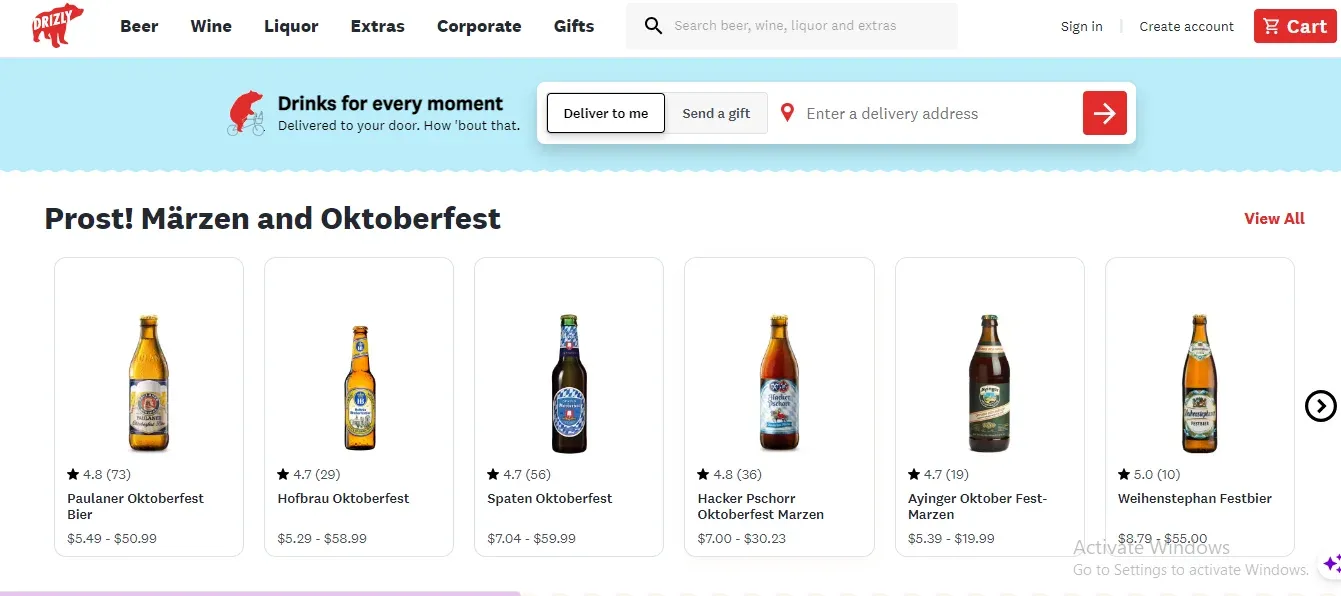
An app like Drizly is a platform that connects customers, local liquor stores, and delivery partners in one seamless system. Users can browse nearby options, place orders, and receive deliveries in real time, making on-demand alcohol delivery quick and convenient.
The Drizly app follows a marketplace model. It doesn’t store or sell inventory itself; instead, it connects users with local stores that handle fulfillment and delivery. This makes Drizly alcohol delivery highly scalable across different cities and regions.
For businesses, this means building more than just an app. A strong liquor app like Drizly serves as a complete ecosystem, connecting customers, vendors, and delivery operations in one place.
From browsing to final delivery, every step is designed for speed, accuracy, and seamless coordination.
Here’s how the complete flow works in an alcohol delivery app like Drizly.
This streamlined workflow is what makes a liquor delivery app solution efficient, scalable, and capable of handling real-time demand.
To successfully build an on-demand liquor delivery app like Drizly, you need features that ensure speed, accuracy, and a seamless user experience.
Each component plays a critical role in making the platform reliable and scalable.
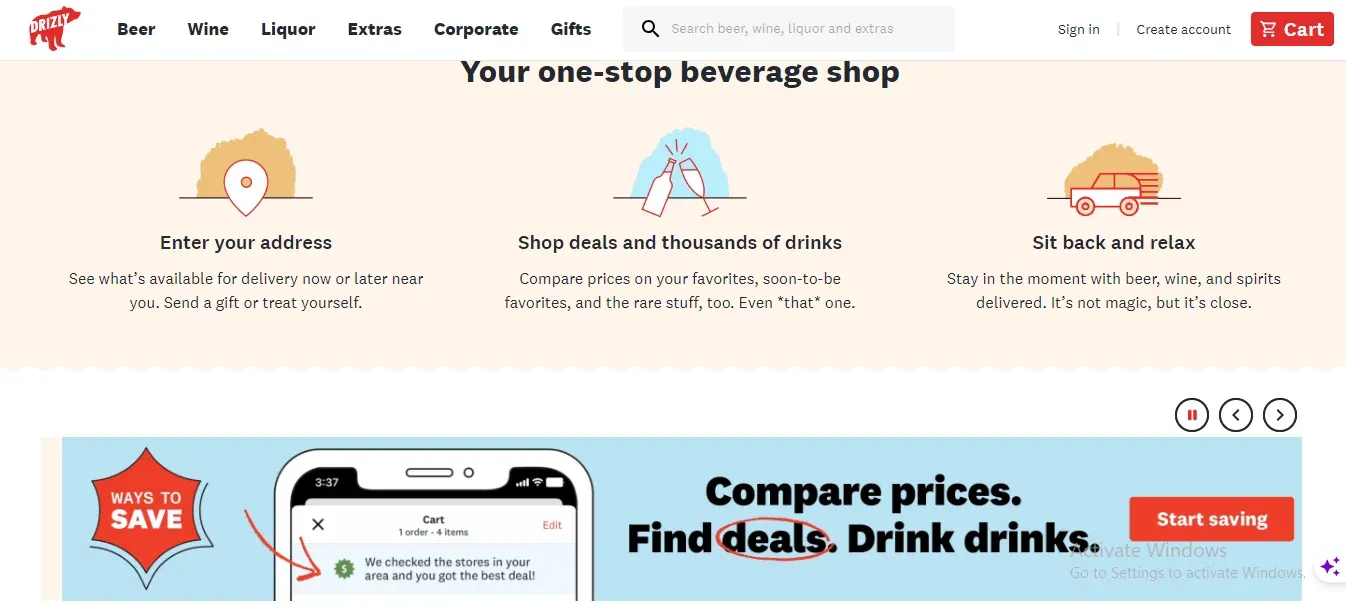
This is where the entire user experience begins. If this feels smooth, users stay and keep coming back.
| Feature | Description |
| Smart Search | Allows users to quickly find products by category, brand, or price, improving discovery in any Drizly application. |
| Cart Management | Let's users add, remove, and update items easily before checkout, ensuring a smooth buying experience. |
| Secure Checkout | Supports multiple payment methods with a frictionless flow, essential for any online liquor delivery app development. |
| Real-Time Tracking | Enables users to track orders from store to doorstep, improving trust and transparency in Drizly alcohol delivery. |
| Push Notifications | Sends updates on order status, offers, and delivery alerts, increasing engagement and retention. |
Behind every fast delivery is a well-optimized delivery system that keeps everything moving without delays.
| Feature | Description |
| Order Alerts | Instantly notifies delivery partners about new orders, helping reduce delays in on-demand alcohol delivery systems. |
| Route Optimization | Provides the fastest delivery routes using map integrations, improving efficiency and delivery time. |
| Status Updates | Allows delivery agents to update order status in real time, ensuring smooth coordination across the platform. |
This is the control centre where operations, performance, and business decisions come together.
| Feature | Description |
| Order Control | Central dashboard for managing, assigning, and monitoring all orders, essential for scaling any liquor delivery app solution. |
| User Management | Handles customers, vendors, and delivery partners in one place, critical for structured liquor delivery app development. |
| Analytics and Insights | Tracks performance metrics, user behavior, and revenue, helping businesses optimize and develop apps like Drizly efficiently. |
These features form the foundation of a successful Drizly app clone, ensuring the platform delivers a consistent, scalable experience for users.
Whether you choose a custom build or a ready-made liquor app solution, the right feature set determines how well your platform performs in real-world conditions.
Building a successful alcohol delivery app requires more than just development; it’s about following the right process from idea to launch an app like Drizly.
Here’s the step-by-step process for building and launching a scalable alcohol delivery app like Drizly.
Understand your target audience, demand patterns, and regional alcohol laws. This is essential if you’re planning how to start a liquor delivery business like Drizly.
Decide between marketplace, single-store, or aggregator models based on your goals. This defines how your platform will operate and grow.
Map how customers, stores, and delivery partners interact across the platform. Clear flows help you build a smooth and efficient experience.
Focus on clean, intuitive design for browsing, ordering, and tracking. A good experience directly impacts user retention and repeat usage.
Build the customer app, delivery app, store panel, and admin dashboard. These modules form the backbone of your liquor delivery platform.
Add payments, maps, notifications, and communication tools—these integrations power real-time operations in any modern alcohol delivery app.
Test all workflows, fix issues, and launch an app like Drizly in a focused market. This approach helps you launch a product like Drizly with fewer risks and better results.
Following this structured approach ensures your app is not just functional, but scalable, reliable, and ready for real-world demand.
The right tech stack decides how smoothly your app runs, scales, and handles real-time operations across the platform.
Let’s take a look at the full tech stack powering a high-performing alcohol delivery app like Drizly.
| Layer | Purpose | Technologies | Why It Matters |
| Frontend (User Interface) | Handles user interactions across mobile and web apps | Flutter, React Native, Swift, Kotlin | Ensures fast, responsive, and consistent user experience across devices |
| Backend (Server Logic) | Manages business logic, orders, users, and workflows | Node.js, Python, Java | Supports real-time processing and scalable operations |
| Database (Data Storage) | Stores users, orders, inventory, and transactions | MongoDB, PostgreSQL, MySQL, Redis | Enables fast queries and reliable data management at scale |
| APIs and Integrations | Connects payments, maps, notifications, and communication | Stripe, Google Maps, Firebase, Twilio | Powers core functionality like payments, tracking, and alerts |
| Cloud and Hosting | Handles deployment, scaling, and infrastructure | AWS, Google Cloud, Microsoft Azure | Ensures uptime, scalability, and performance under high demand |
| Real-Time Systems | Enables live tracking and instant updates | WebSockets, Firebase Realtime DB, Socket.io | Critical for real-time order tracking and delivery coordination |
| Authentication and Security | Manages user login, access control, and data protection | OAuth, Firebase Auth, Auth0 | Ensures secure access and supports compliance requirements |
| DevOps and Deployment | Automates deployment, scaling, and system management | Docker, Kubernetes, CI/CD pipelines | Improves development speed and system reliability |
| Analytics and Monitoring | Tracks user behaviour, performance, and system health | Google Analytics, Mixpanel, Firebase Analytics | Helps optimize performance and improve user experience |
| GenAI and Automation Layer | Adds intelligence through automation and personalization | OpenAI, Gemini, LangChain, Pinecone, TensorFlow | Enables recommendations, AI chatbots, and demand prediction using tools like BotPenguin |
This complete tech stack is what powers modern platforms like the Drizly app, enabling seamless ordering, real-time tracking, and scalable operations.
Whether you choose custom app development or a ready-made solution, having the right technology foundation ensures your app performs reliably as it grows.
The cost to create an alcohol delivery app depends on the level of features, scalability, and complexity you plan to build.
Let’s take a clear look at the estimated development cost across different stages.
| App Level | What You Get | Best For | Estimated Cost |
| MVP (Basic Version) | Core features like product listing, cart, checkout, basic tracking, and single-store flow | Startups testing the idea or entering the market quickly | $15,000 – $30,000 |
| Mid-Level App | Multi-store support, real-time tracking, payment integrations, delivery management, and an admin panel | Growing businesses looking to scale operations and improve user experience | $30,000 – $80,000 |
| Advanced Platform | Full-scale marketplace, AI features, analytics dashboard, multi-city support, automation, and high scalability | Enterprises or businesses building a complete app like Drizly | $80,000 – $150,000+ |
The final cost can vary significantly based on several important factors:
Starting with a focused MVP and scaling gradually is often the most practical approach for building a reliable, scalable alcohol delivery platform.

Building the app is just the starting point. What truly drives growth is how well your platform generates consistent and scalable revenue.
Here are the key monetization models that power a successful alcohol delivery app like Drizly.
| Revenue Model | How It Works | Business Impact |
| Commission per Order | Charge a percentage from partner stores on every completed order | Creates a scalable revenue stream directly tied to order volume and platform growth |
| Delivery Fees | Apply fixed or dynamic charges based on distance, time, or demand | Generates consistent per-order income and helps balance operational costs |
| Subscription Plans | Offer premium memberships with perks like free delivery or priority slots | Builds recurring revenue while improving customer retention and lifetime value |
| In-App Advertising | Allow brands and stores to promote products via featured listings and placements | High-margin revenue stream that grows as traffic and vendor competition increase |
To build a scalable app like Drizly, it’s important to understand how the marketplace model generates revenue while staying asset-light.
Here’s how the model works in practice.
| Model Element | How It Works | Business Impact |
| Store Onboarding and Monthly Fees | Stores pay a recurring fee (typically $100 to $1,000+ per month in 2026) to get listed and access customers | Creates predictable revenue and ensures quality vendor participation |
| No Inventory Ownership | The platform does not hold inventory; stores manage products and fulfillment | Reduces costs and allows faster scaling across regions |
| Local Store Fulfillment | Orders are fulfilled by nearby stores instead of central warehouses | Enables quicker delivery and wider product availability |
| Delivery Fee Model | Delivery fees (around $3 to $10+ per order) are set by stores based on distance and demand | Keeps operations flexible while maintaining platform margins |
This hybrid monetisation structure is what makes platforms like Drizly scalable without heavy operational complexity. For a detailed breakdown of how Drizly actually makes money, read our Drizly Business Model and Revenue Model.
If you’re planning to create an alcohol delivery app like Drizly, the real advantage lies in designing a model that balances recurring revenue with operational simplicity. This is where working with experienced teams, like those behind scalable liquor delivery app development solutions at AppsRhino, can help you avoid early structural mistakes.
By combining subscription-based income, flexible delivery pricing, and an asset-light approach, you can build a platform that grows efficiently while maintaining strong long-term margins.
The real advantage isn’t just going online, it’s building a system that drives consistent demand and predictable revenue.
Here’s what makes a Drizly-like model powerful from a business standpoint.
You don’t need to stock or manage inventory yourself. The marketplace approach reduces capital investment while maintaining healthy margins.
Alcohol purchases are frequent and occasion-driven, which naturally increases order frequency. This creates a steady revenue cycle instead of sporadic sales.
You tap into nearby store inventory and deliver instantly. This makes your platform highly relevant for hyperlocal demand and urgent orders.
Adding new stores expands your catalogue centre without operational overhead. This allows you to grow supply and revenue without increasing infrastructure.
Delivery fees and pricing can be adjusted based on time, location, and demand. This helps maximize revenue during peak hours and high-demand periods.
No warehousing, reduced logistics burden, and partner-led fulfillment improve cost efficiency. This results in better margins as the platform scales.
You gain insights into buying patterns, peak hours, and product demand. This allows you to strategically optimize pricing, promotions, and partnerships.
These Benefits are why more businesses are choosing to build an on-demand liquor delivery app like Drizly, focusing on efficiency, margins, and long-term growth instead of just presence.
Choosing between ready-made and custom development depends on how fast you want to launch and how far you want to scale. Here’s a clear breakdown to help you decide.
| Factor | Ready-Made Solution | Custom Development | Hybrid Approach |
| What It Means | Pre-built platform with basic customization | Built from scratch based on your requirements | Start with the base and customize gradually |
| When to Choose | Quick launch, testing the market | Long-term scalability and differentiation | Balance between speed and flexibility |
| Price (2026) | $10,000 – $25,000 | $50,000 – $150,000+ | $25,000 – $80,000 |
| Time to Launch | 2–4 weeks | 3–6 months | 4–10 weeks |
| Flexibility | Limited | High | Medium to high |
| Branding Control | Basic | Full control | Improves over time |
| Maintenance | Low to moderate | High (full control) | Moderate |
So, where do you land?
If you're just starting and figuring out how to start a liquor delivery business like Drizly, a ready-made approach can help you enter the market quickly. But if your goal is to build a strong, scalable platform that stands out, custom development is where the real advantage lies.
In many cases, businesses begin with a base and evolve as they grow. This is where working with experienced teams, like those offering scalable alcohol delivery app development services at AppsRhino, can make the transition smoother and more strategic.
At the end of the day, the choice isn’t just build or buy; it’s about how far you want to take your platform.
Building a successful app like Drizly is not just about development; it’s about choosing a partner who understands how these platforms actually run, scale, and generate revenue.
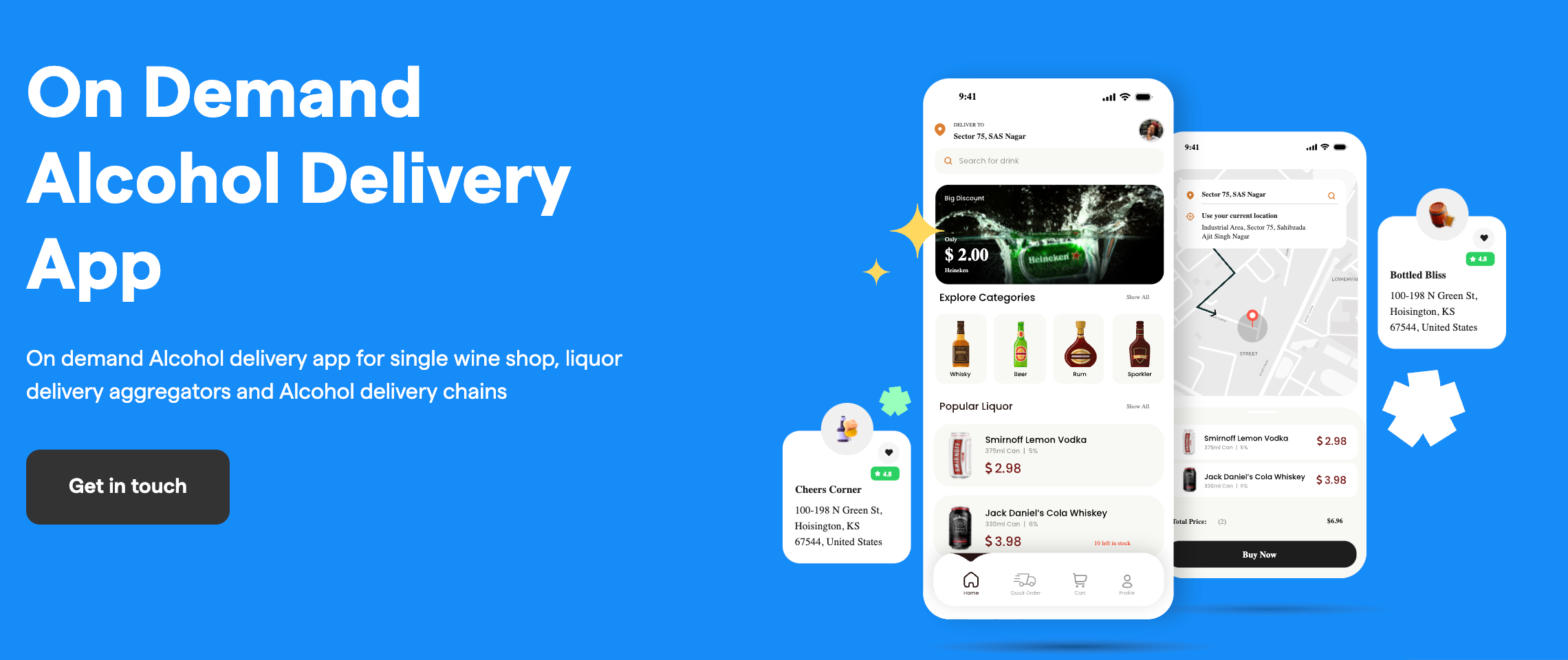
Here’s what truly matters when making that decision:
This is where experienced teams make a real difference. With deep expertise in liquor delivery app development and building real-world marketplace systems, AppsRhino focuses on creating platforms that are not just functional but built for long-term growth.
If you’re planning to build an on-demand liquor delivery app like Drizly, the right partner won’t just help you launch; they’ll help you build something that actually scales and sustains.
The alcohol delivery market isn't slowing down, and the window to build something meaningful in this space is still open.
You now know what goes into a Drizly-like app: the features, the tech, the compliance considerations, the cost, and the development approach that actually works. The blueprint is there.
What moves next is your decision.
Whether you're validating an idea or ready to build a full-on-demand liquor delivery platform, the right development partner makes that distance shorter than you think.
Custom Development
7 Apr 2026
Tell us what your business actually runs on today, and we will map what it takes to make it one system.